The Myriad Year Clock
1851 · Variable-Hour Spring Clock · Work 774 of 1,871
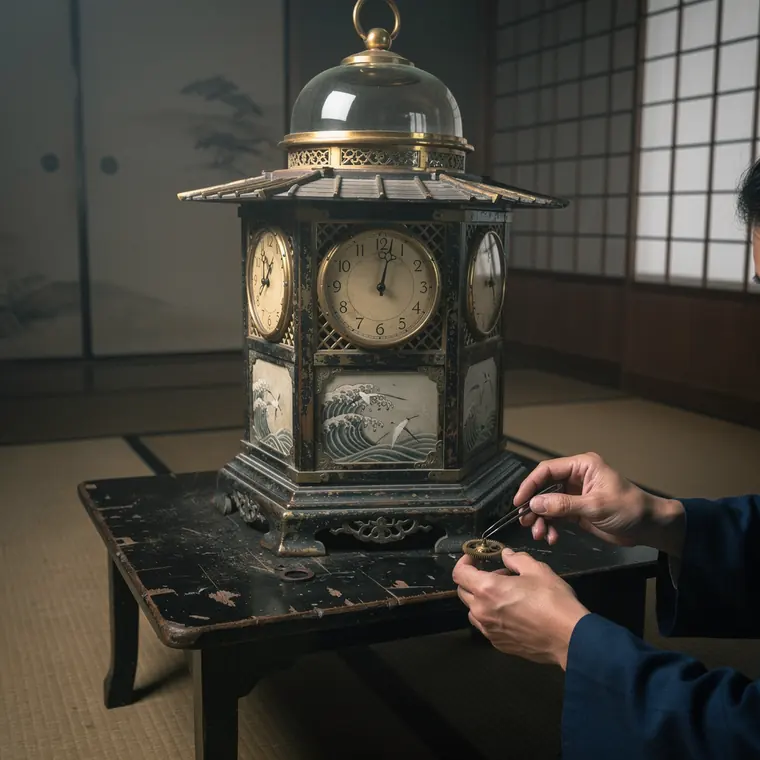
A hexagonal clock of 1851 on a low lacquered table in a workshop in Kyoto, tatami mats and plain paper screens, the clock fifty-seven centimetres high, below a broad hexagonal base of dark lacquer with gold lattice and inset pale panels painted with waves and birds, above it a hexagonal lantern of dark wood, in each face a gilded panel with one small round dial seen at a slant and soft in focus, a projecting roof with a brass frieze, on top a glass dome over a brass ring and hoop, two hands in indigo blue sleeves setting a brass gear with tweezers, soft light through the paper screen on the right.
- What it was used for
- A clock by Hisashige Tanaka, finished in 1851. Six dials on its sides, and above them an astronomical model with the sun and moon rotating above and below a map of Japan. The dials showed Western time, Japanese temporal time, the day by the solar calendar, the day of the week, the year in the Chinese system, and the day of the lunar calendar by the moon's shape. Just over 1,000 parts; two strong springs drove the movement and two more the striking train, and Tanaka expected it to run for several months, where ordinary Japanese clocks ran for a day. Tanaka meant to sell it to a feudal lord or a wealthy merchant.
- What was new
- The achievement is not a world first but the automation of the temporal hours. Edo Japan divided day and night separately into 6 koku each, so the length of an hour changed with the season; the plates of warikoma clocks were almost always moved by hand for this; one exception is a clock of the Takekawa family with a simpler mechanism. Tanaka's movement shifted the plates itself, using about 10 small sun-and-planet wheels, an insect-shaped cog and gears with teeth on one side only. The essay by Hashimoto (UTCP, University of Tokyo) states that the clock changed the length of daylight continuously and so indicated seasonal time more accurately than the calendars, which jumped only at each sekki. The barb: nobody bought it. It is said that one lord wanted it, but his men talked him out of it because it seemed extraordinarily expensive - in the Saga clan's service Tanaka then built useful rather than entertaining machines.