The Second Minute Hand
1852 · Dual-Time Public Clock · Work 776 of 1,871
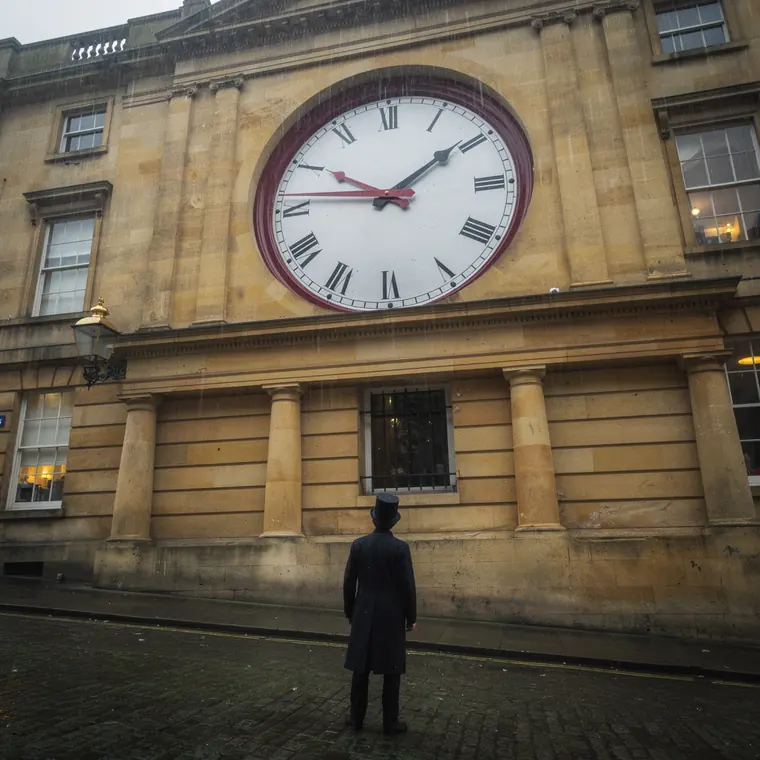
The clock on the front of the merchants' exchange in Corn Street in Bristol in 1852, a facade of honey-yellow sandstone with plain pilasters and a smooth string course, the dial a ring just over one metre across set flat on the stone, dark red on a plain white ground, seen from directly below at a very steep slant, foreshortened to a narrow oval and soft in focus, from its centre a short dark red hour hand and two long minute hands, one dark red and one black, their tips about ten centimetres apart, below a man in a dark coat and tall hat seen from behind looking up, wet cobblestones, grey rain light from overhead.
- What it was used for
- The clock above the old Corn Exchange in Corn Street, Bristol, carries two minute hands. The red one shows Greenwich time, the black one Bristol local time, about 10 minutes behind; the small plaque beneath William Langford's clock on College Green gives Bristol's position as 10 minutes 23 seconds west of the prime meridian. The occasion: from 1841 the Great Western Railway and the Bristol & Exeter Railway ran out of Temple Meads, from 1844 the Bristol & Gloucester, and the trains needed a single time. Bristol adopted standard time, according to Bristol24/7, only in 1852, 5 years after the rest of the country; the same year Langford's electric clock took its time by telegraph from the Royal Observatory Greenwich.
- What was new
- What was new was not the technology but the move: a second hand instead of a changeover. One dial now showed two times at once and left open which one held. Secret Bristol links the hand to 1847, when Britain adopted Greenwich time as railway time, and gives 1822 as the clock's date; Free-Range History places it after 1841 and before the official adoption in September 1852. The barb: the dispute was settled more than 170 years ago and the loser still hangs on the dial - the black hand shows a time nobody keeps.
What the sources leave open: Which group asked for the second hand, and who fitted it, is not stated by the sources consulted. None of them gives a documented year for the hand: Secret Bristol links it to 1847, Free-Range History gives no year.