The Quartz Crystal Clock
1927 · Quartz Oscillator Timekeeping · Work 784 of 1,871
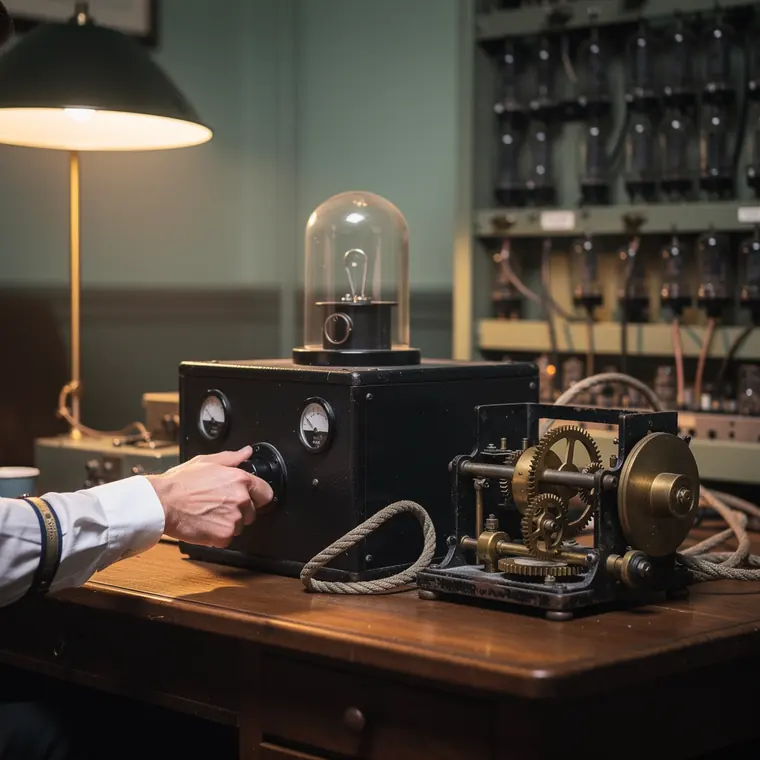
A quartz crystal clock of 1927 on an oak table in a laboratory of a telephone company in New York, its oscillator a black crinkle-painted metal box forty centimetres wide, on its front two small round instrument faces, plain and dim, either side of a large round black knob, on top a tall clear glass dome over a small black holder with a round window, beside it an open black metal frame with brass gear wheels and a flat disc motor, braided cables running to a tall rack of glass valves, a hand in a white shirt sleeve with a sleeve garter turning the knob, lamplight from the left.
- What it was used for
- A clock whose rate does not depend on a pendulum but on a vibrating quartz crystal. Joseph W. Horton and Warren A. Marrison built it in 1927 at the Bell Telephone Laboratories in New York; Guinness World Records gives a crystal oscillating at 50,000 hertz and a frequency divider that turned this into a usable clock reference, and dates the first public showing to an academic conference in October 1927. The NIST paper on the leap second calls quartz clocks an outgrowth of radio technology in the 1920s and 1930s. According to Guinness, quartz oscillators were already generating time reference standards in several countries by 1929. The NIST table gives quartz clocks, introduced in 1927, a typical timing uncertainty of ±100 microseconds over 24 hours.
- What was new
- It was not the first clock and not the first use of piezoelectric quartz - what was new was where the rate came from: not from a mass swinging because gravity pulls it back, but from a crystal vibrating because current deforms it. It was not built by clockmakers but by a telephone company. The barb: the new clock first called into question not itself but its measure. The NIST paper on the leap second reports that A. Scheibe and U. Adelsberger were the first to report the seasonal variation of the Earth's rotation in 1936, using quartz-crystal clocks at the PTB. And it displaced what had been the standard before it: by the 1940s, according to NIST, quartz clocks had replaced the Shortt pendulum as primary laboratory standards.