The Speaking Clock
1933 · Optical Sound Time Announcer · Work 786 of 1,871
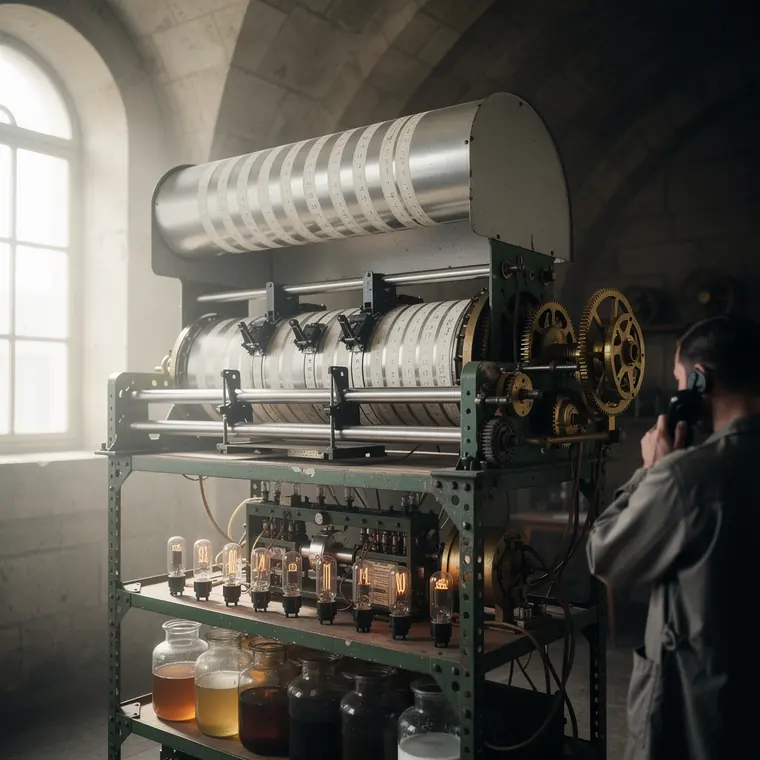
The speaking clock machine of 1933 on an open angle-iron frame in a stone-vaulted ground-floor room of the observatory in Paris, at the top a horizontal pale aluminium cylinder sixty centimetres long and thirty across carrying narrow paper bands as fine pale stripes, a curved sheet-metal hood swung back beside it, in front of the drum three slim black sound heads on carriages riding steel rails, to the right a train of brass gears, in the shelves below tiers of glass valves and glass battery jars, a technician in a grey coat seen from behind holding a black telephone handset, daylight from a tall window on the left.
- What it was used for
- A telephone service that speaks the time. Ernest Esclangon, director of the Paris Observatory, had it set up because the building's single telephone line was permanently occupied by the public asking the time; the speaking part was built by the Brillié firm. A cylinder carried 3 sets of sound tracks cut from paper and read by photoelectric cells, with a valve circuit selecting the announcements: one track for the hours 0 to 23, one for the minutes 0 to 59, one for the seconds 10, 20, 30, 40 and the announcement "au quatrième top". A precision pendulum clock kept it all in step, the pips came from the Observatory's fundamental clock, and the zero of each minute fell at the start of the fourth pip. After 3 months of trials the service opened on 14 February 1933 under the number ODEon 84 00.
- What was new
- What was new was not sound recording but the assembly: the announcement was not played back but composed from 3 separate tracks and synchronised by a precision pendulum clock - a clock that speaks with a recorded voice and still does not lose time. The BHPT account names Esclangon as the creator of the world's first speaking clock. The barb: the device was meant to free up one telephone line, and on its first day it drew more than 140,000 requests, of which only 20,000 could be served - 20 lines had been provided. The thirst could not be slaked: in 1991 the service still counted about 200,000 calls a day on 36 99. It was shut down on 1 July 2022.
What the sources leave open: BHPT and 1-jour.fr call Esclangon's device the world's first speaking clock; neither tests that priority against earlier announcement services.