The Caesium Beam
1955 · Caesium Atomic Beam Standard · Work 792 of 1,871
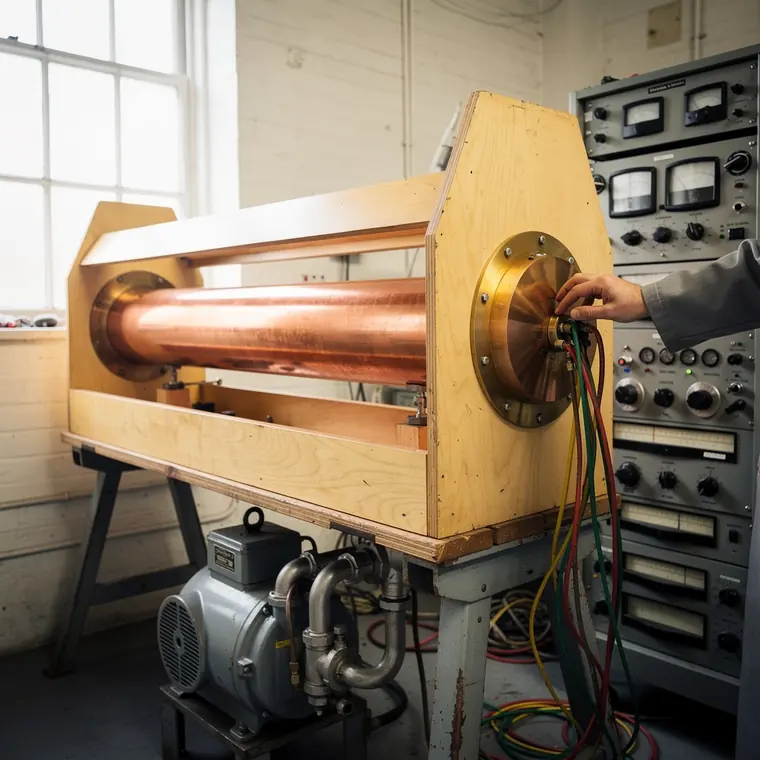
A caesium atomic beam apparatus of 1955 in a laboratory in Teddington, a horizontal tube of reddish copper one and a half metres long with brass flanges, on two grey cast-iron trestles, at each end a round brass housing carrying a polished aluminium disc, held in a cage of pale varnished plywood with pointed ends, under the left end a grey cylindrical vacuum pump with curved pipes, from the right end a bundle of red, green and yellow wires running to a rack of grey electronic drawers, a hand in a grey coat sleeve at a knob, daylight from tall windows on the left, whitewashed wall.
- What it was used for
- The caesium atomic beam apparatus of Louis Essen and J. V. L. Parry at the National Physical Laboratory in Teddington, which on Lombardi's account was put into service as a time standard in June 1955. It served to realise frequency and time interval, and so made the irregularities of the Earth's rotation measurable. The Science Museum Group gives the instrument as 463 kg and 1685 x 607 x 1732 mm and puts its drift at about 1 second in 300 years, some 30 times better than the quartz clocks of the 1930s and about 300 times better than the best pendulum clocks. Essen and Parry published their work in Nature 176, 280-282, in 1955.
- What was new
- It was not the first caesium apparatus: Lombardi records that the resonance width of the device tried at NBS in 1952 was too wide to serve as an accurate time standard, and that NBS-1 only became a working time standard in Boulder in 1958. The Science Museum Group calls the NPL instrument "the first successful atomic clock". Lombardi gives an originally reported accuracy of 1 x 10^-9, that is 0.1 ms per day. In 1967 the second was redefined as 9,192,631,770 transitions of the caesium atom. The barb: on NPL's own account Essen was quietly warned not to continue his contradiction of Einstein's relativity, and retired in 1972.
What the sources leave open: The accuracy figures diverge: Lombardi gives an originally reported 1 x 10^-9 (0.1 ms per day), the Science Museum about 1 second in 300 years for the same clock, and NPL first one part in ten thousand, then one part in a million million.
Further reading
- Caesium Atomic Clock, 1955, Science Museum Group Collection (1962-59)
- Louis Essen, History / Famous faces, National Physical Laboratory
- Michael A. Lombardi, The Evolution of Time Measurement, Part 3: Atomic Clocks, IEEE Instrumentation & Measurement Magazine, Dezember 2011 (NIST)
- L. Essen, J. V. L. Parry, An Atomic Standard of Frequency and Time Interval: A Cæsium Resonator, Nature 176, 280-282 (1955)