The Caesium Clock of Braunschweig
1969 · Primary Caesium Clock · Work 796 of 1,871
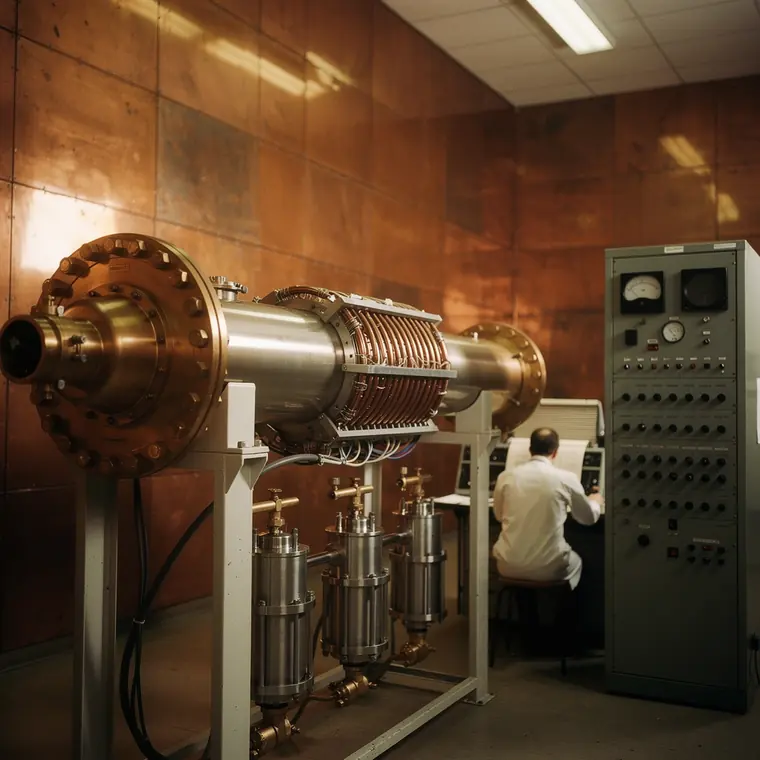
A caesium beam clock of 1969 in a tall hall with copper-clad walls in Braunschweig, a horizontal beam tube of matt stainless steel several metres long on a pale grey steel frame, at each end a thick flange with a ring of bolt heads, around the middle a ring of magnet coils, cylindrical vacuum pumps hanging beneath the tube, at one side a rack of electronics with rows of plain black knobs, small dark lamps and round dark meter windows, a physicist in a white coat seen from behind at a desk with a strip recorder, fluorescent light under a high ceiling, the copper wall panels glowing dull orange-brown.
- What it was used for
- CS1, the first atomic clock of the Physikalisch-Technische Bundesanstalt in Braunschweig, put into operation in 1969. It realised the SI second; according to the PTB, the official transmission of a standard frequency over the long-wave transmitter DCF77 began in 1959, then still from quartz clocks regulated by astronomical observations, and only at the end of the 1960s did the PTB regulate them against atomic clocks in Braunschweig. Under the Zeitgesetz of 25 July 1978 the responsibility for Germany's legal time lies with the PTB.
- What was new
- The PTB describes its own design as novel for the time and as differing in many details from the primary clocks of other national institutes and from commercial caesium clocks: an axially symmetric beam, an axially directed C-field and magnetic lenses selecting slow atoms from a narrow velocity interval - which allowed the systematic frequency shifts to be measured with small uncertainty. The PTB gives CS1 a relative uncertainty of 7 x 10^-15, equal to 0.22 microseconds over a year. The barb: CS1 ran practically without interruption from 1978 to 1995, until a fundamental renovation became unavoidable, and from 1991 it was CS2 that supplied the seconds of legal time.
What the sources leave open: The PTB's uncertainty figure for CS1 is undated and does not explicitly reflect the state of 1969; for the estimate the PTB refers to several later publications.