The World Clock
1969 · Public Time Zone Clock · Work 797 of 1,871
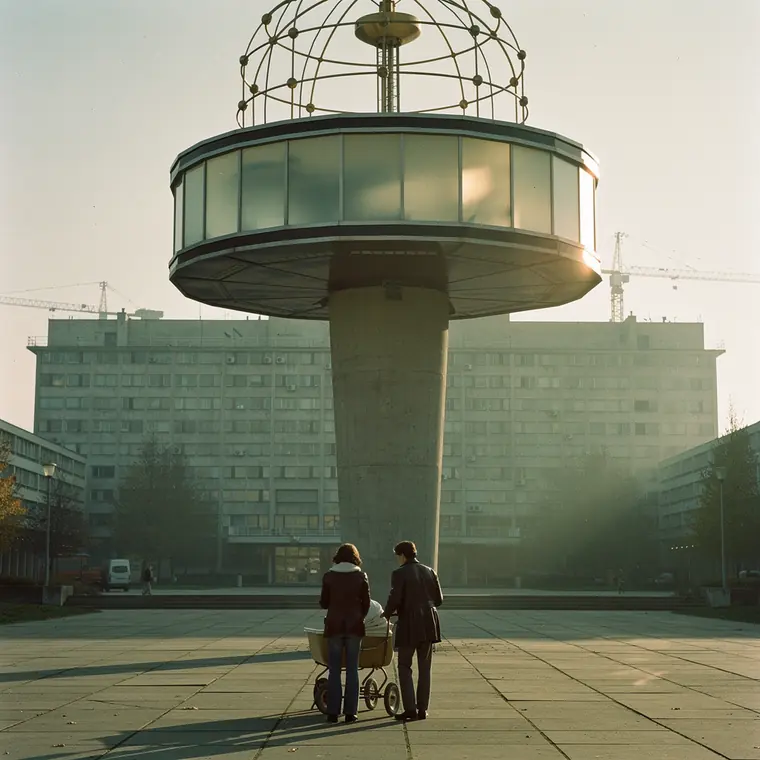
The world time clock of 1969 on a wide square of concrete slabs in eastern Berlin on an early autumn morning, a column about ten metres tall carrying a broad flat many-sided metal drum, its outer faces a ring of plain smooth panels of pale frosted glass between two narrow dark bands, the whole drum against the low sun so that it stands as a dark silhouette with a bright rim, above it thin metal rings with small spheres against a pale sky, the shaft a plain smooth concrete column, two young people in leatherette jackets seen from behind with a pram, behind them the perforated facade of a high hotel block and building cranes, flat morning light from the right.
- What it was used for
- The Urania World Clock on Berlin's Alexanderplatz, designed by the industrial designer Erich John as part of the socialist redesign of the square and presented to the public on 30 September 1969 after 9 months of construction. 24 segments schematically represent the 24 time zones of the Earth, the most important city names are engraved on aluminium plates, and above sits a simplified model of the solar system. According to the City of Berlin, a converted Trabant gearbox still serves as the motor for the hour ring. The clock was and is a meeting point; it has been a listed monument since July 2015.
- What was new
- What marks it out is the execution: a turning hour ring above 24 segments, making the hour in every zone legible from outside, driven by a converted mass-produced car gearbox, as furniture in a public square. The barb: what the clock shows is written by politics. The Berlin paper taz reported on 13 July 2015 that in the 1997 refurbishment 20 further cities were engraved and entries altered - "Leningrad" became "St Petersburg", "Mexico City" became "Mexiko-Stadt", while Tel Aviv and Managua were missing in the original state. What was listed is therefore not the object of 1969: what one sees today is not the original state.
What the sources leave open: None of the sources claims priority for the World Clock, so it cannot be presented as the first world clock.