Centrifugal Governor
1788 · Control Engineering · Werk 93 von 1.871
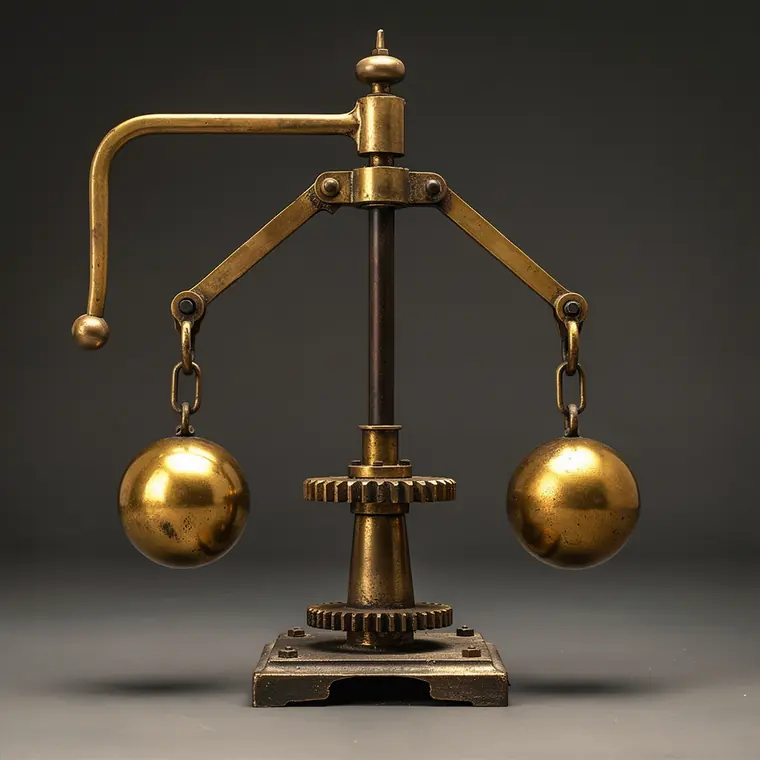
A centrifugal governor in close view: an upright spindle turned by bevel gears at its foot, two arms hinged at the top of the spindle hanging down on either side, a heavy brass ball at the lower end of each arm, the balls swung outward and upward by the spinning, two short links running from the arms down to a sleeve that slides on the spindle, the sleeve lifted as the balls fly out, a lever resting on the sleeve and the throttle linkage running away from it to the steam valve, the balls free on hinged arms.
- Wofür es benutzt wurde
- Der Fliehkraftregler hält die Drehzahl einer rotativen Dampfmaschine annähernd konstant, wenn Last oder Dampfzufuhr schwanken. Er greift dazu an der Drosselklappe an. Die erste Maschine mit Regler war die Lap Engine von 1788, gebaut für Matthew Boultons eigene Soho Manufactory in Birmingham; sie trieb dort 43 Poliermaschinen an, siebzig Jahre lang. Die Datierung ist uneinheitlich: eine Fachdarstellung nennt November 1788 als Entwurf und Anfang 1789 als ersten Einsatz. Boulton und Watt haben den Regler nicht patentiert. Der Grund liegt bei Watt selbst: er hielt ihn für keine Erfindung, sondern für die Übertragung eines Mühlenbauteils.
- Was daran neu war
- Fliehkraftpendel gab es im Mühlenbau längst. Der lift-tenter regelte in Wind- und Wassermühlen den Abstand der Mahlsteine, also die Feinheit des Mehls. Neu war nicht die Mechanik, sondern der Angriffspunkt: Watts Regler griff nicht in den Arbeitsvorgang ein, sondern in die Energiezufuhr. Ein Reglerpatent von Thomas Mead liegt im Mills Archive. Der Preis der Bauart ist bauartbedingt und blieb es: der Regler regelt rein proportional und trifft die Solldrehzahl deshalb nur in einem einzigen Betriebspunkt genau - Kritiker nannten ihn einen Mäßiger, keinen Regler. Ab dem frühen 19. Jahrhundert kamen Berichte über pendelnde Regler auf. Maxwell antwortete 1868 darauf mit "On Governors", Proceedings of the Royal Society 16, S. 270-283.
Zum Weiterlesen
- Science Museum Group: Rotative Steam Engine by Boulton and Watt, 1788 (Lap Engine)
- Otto Mayr, Feedback Mechanisms in the Historical Collections of the NMHT, Smithsonian Studies in History and Technology 12 (1971)
- Stuart Bennett, A Brief History of Automatic Control, IEEE Control Systems Magazine, Juni 1996, S. 17-25
- J. C. Maxwell, On Governors, Proc. R. Soc. London 16 (1868) 270-283