Mine Winder
1820 · Winding Engine · Work 100 of 1,871
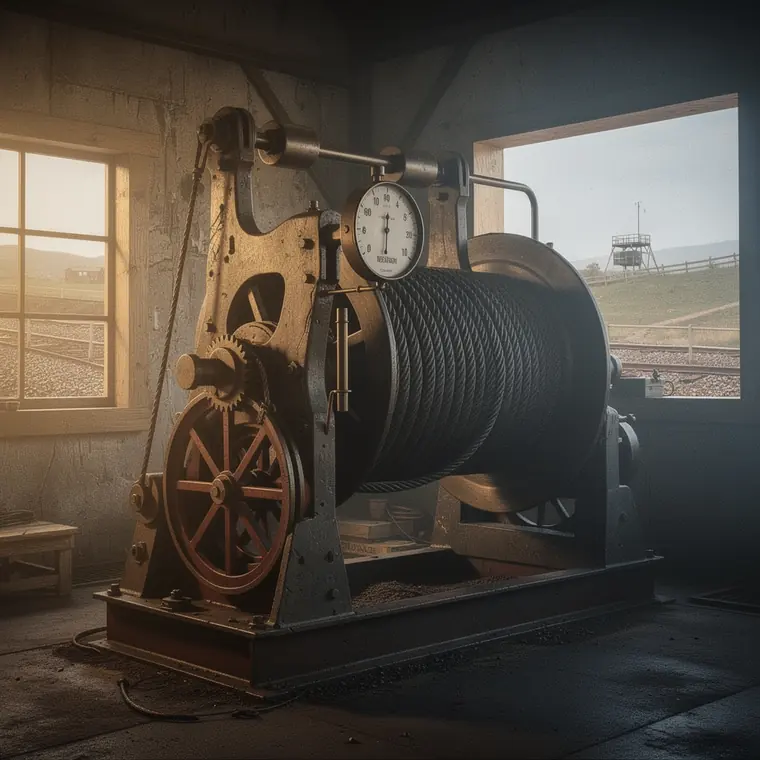
A winding engine in its house beside a headframe, grooved drum with steel rope coiled across it, indicator dial showing cage position, pit yard visible through the window.
- What it was used for
- The steam winder lifted coal, ore and men out of the shaft. At first it was often the same engine as the pumps: from 1803 Franz Dinnendahl built steam engines in the Ruhr first for drainage, later as combined winding and pumping engines. How laborious this was around 1820 is shown at Hetton in Durham: sinking began on 19 December 1820, the seam was not reached until 3 September 1822, and in the first three months 5,000 gallons of water a minute had to be raised. What such an engine looked like is shown by the oldest surviving example from the Ruhr coalfield, built about 1840 - maker and year are disputed, Harkort of Wetter in 1840 or Nering, Boegel & Co. of Isselburg in 1839: vertical double-acting cylinder with a beam on a column, slide valve, hand reversing by two levers, a 2.6 m flywheel; the 4:1 spur gearing and the two winding drums were added by the museum in 1932.
- What was new
- What was new around 1820 was not winding speed but that shafts became possible at all where water stood. Durham Record Office calls the sinking through permeable limestone at Hetton a first; whether it truly was the first cannot be checked from here. The price of depth was paid at Hartley on 16 January 1862. The beam of the pumping engine broke and fell into the shaft; 204 men and boys died because that shaft was also the only way out. Three of the eight men in the wrecked cage came out alive; of the two shifts below ground, none. So it was the pumping engine, not the winder - what killed them was that the way up and the way out were the same hole. The Act of that same year, 25 & 26 Vict. c. 79, required at least two shafts or outlets for every seam then being worked.
Further reading
- National Coal Mining Museum for England: The Hartley Calamity
- legislation.gov.uk: Coal Mines Act 1862 (25 & 26 Vict. c. 79)
- Deutsches Bergbau-Museum Bochum: Älteste erhaltene Dampffördermaschine des Ruhrbergbaus (museum-digital)
- Stadt Essen, Historisches Portal: Franz Dinnendahl
- montan.dok, Deutsches Bergbau-Museum Bochum: Dampffördermaschine, Objektdokumentation (Ref. 61651)
- North East Heritage Library: The New Hartley Pit Disaster
- Newcastle City Council, Sitelines HER 2989: Hetton Colliery