Condie Steam Hammer
1850 · Precision Forging · Work 102 of 1,871
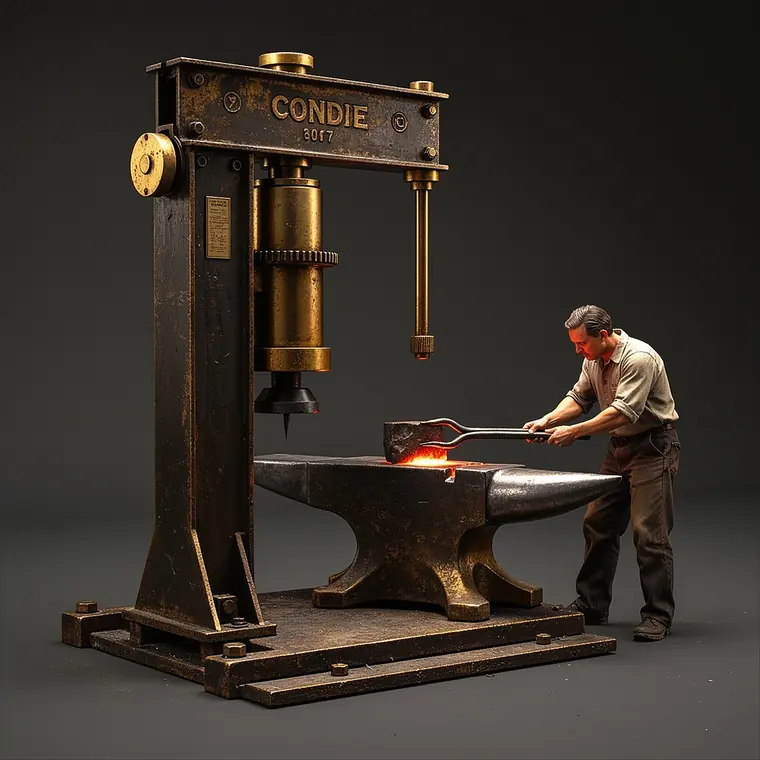
A Condie single-frame steam hammer at work: one tall upright cast-iron standard rising beside the anvil, an overhanging head at the top of the standard, beneath it the steam cylinder itself sliding up and down in vertical guides on the standard with the hammer head bolted directly to its underside, the piston rod fixed and standing still above the moving cylinder, the hammer falling square onto the anvil block set in the floor directly below it, the smith positioning a small forging with tongs under the falling tup.
- What it was used for
- John Condie built patent steam hammers in Glasgow, made at the Govan Bar Iron Works in the Gorbals and advertised, among other places, in the Post Office Glasgow Directory for 1859-60. They worked for Clyde shipbuilding, where shafts, anchors and crankshafts were forged. According to the caption at TheGlasgowStory, shafts for Brunel's Great Eastern were forged a few years earlier by Condie steam hammers; no independent confirmation could be found. The ship's crankshaft came from Fulton and Neilson at the Lancefield forge and was reckoned the largest forging ever made. The ship they forged for cost an estimated 500,000 pounds and was later sold for 25,000. She never earned money carrying passengers; she earned it laying cable, over 26,000 nautical miles of submarine telegraph cable between 1866 and 1878.
- What was new
- What was new about 1850 was no longer the steam hammer but its standing: within twenty years Nasmyth's invention of 1842 had become a trade good, built by a Glasgow firm on its own patents and advertised in the city directory beside coal, boilers and ships' stores. A Clyde forge wanting a shaft no longer bought its hammer at Patricroft but in the Gorbals. The barb is in what survives: of Condie's hammers the picture that remains is an advertisement. The strongest claim made for them - that they forged the shafts of the Great Eastern - appears in the caption to that same advertisement and could not be confirmed anywhere else. This is what an outfitter's afterlife looks like.