Ramsbottom Rolling Mill
1857 · Rail Rolling Mill · Work 103 of 1,871
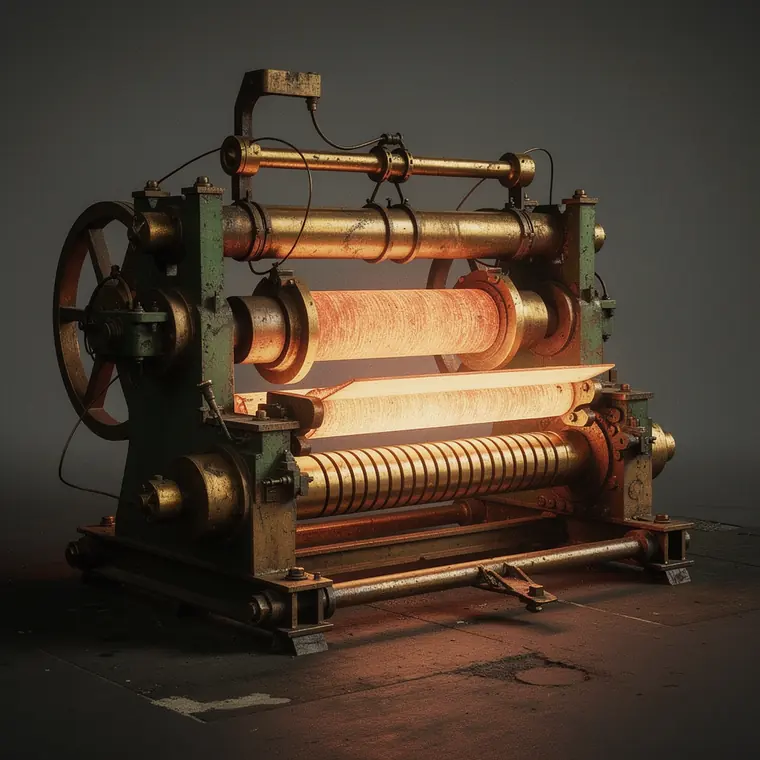
A rail rolling mill in operation, a white-hot rail section snaking between successive stands, roller tables and manipulators guiding it through each pass.
- What it was used for
- Crewe was the main works of the London and North Western Railway. From 1853 the works made its own wrought iron and rolled its own rails. In 1856 John Ramsbottom took charge of the rail rolling mill; in 1857 he became Locomotive Superintendent at Crewe. How short-lived iron rails were, the Pennsylvania Railroad said of its own track in 1864: in some positions the iron rail does not last six months. Against that same problem Crewe worked on: a Bessemer converter in 1864, and in 1868 Siemens-Martin furnaces, which Grace's Guide calls the first industrial-scale use anywhere. Under Ramsbottom locomotive output rose from about 30 engines a year to 74 in 1866.
- What was new
- Ramsbottom's reversing rolling mill drove the rolls directly from a steam engine without a flywheel: engine and rolls reversed for every pass, so the piece ran to and fro instead of being carried round the mill. The year given for his description to the Institution of Mechanical Engineers varies in the literature between 1864 and 1866; SteamIndex records that the mill had been running seven months at the LNWR steel works at Crewe when he described it. The barb is in its own success: an English trial of 1862 showed a steel rail that in two years outlasted the eighteenth renewal of the iron rails beside it. The iron-rail mill the plant was built for thereby lost its object; two years later Crewe had its first Bessemer converter.
Further reading
- SteamIndex: John Ramsbottom (Schienenwalzwerk 1856, umsteuerbares Walzwerk, Bessemer- und Siemens-Martin-Anlage)
- Grace's Guide: Crewe Works (1853 eigenes Schmiedeeisen und Schienen, 1864 Bessemer, 1868 Siemens-Martin)
- IMechE Archive: From the Archives - John Ramsbottom (Lokomotivbau 30 auf 74 im Jahr)
- ExplorePAhistory (Pennsylvania Historical and Museum Commission): First Steel Rails (Pennsylvania Railroad 1864 zur Lebensdauer der Eisenschiene; englischer Schienenversuch 1862)