Steam Crane
1850 · Harbour Crane · Work 104 of 1,871
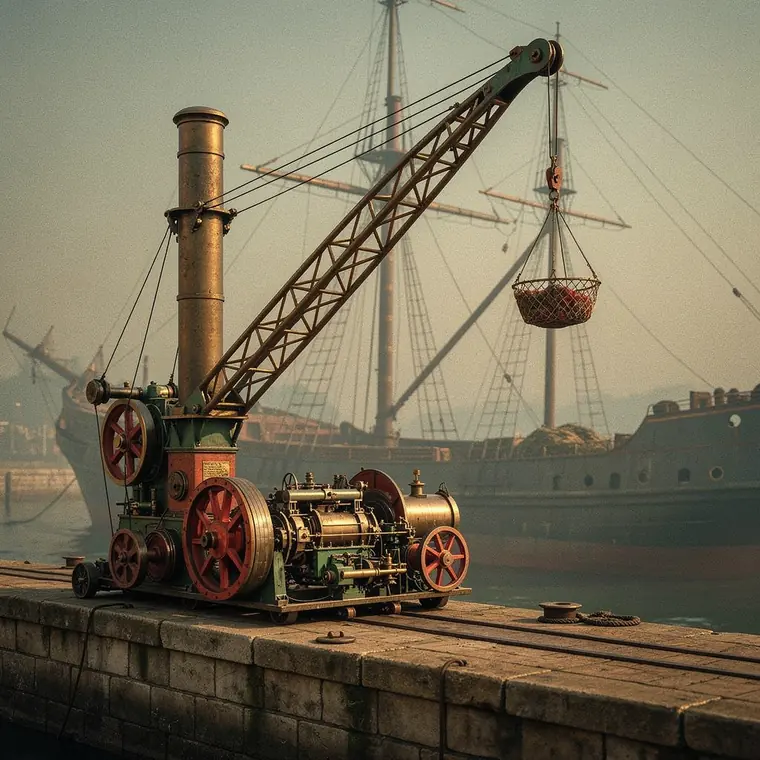
A steam crane on a stone quayside, vertical boiler beside the winch drums, jib swung out over a ship's hold, cargo net rising, masts and rigging behind.
- What it was used for
- Steam cranes lifted on quays, in goods yards, quarries and on building sites. No dated machine could be verified for 1850; the documented ones are later. Alexander Chaplin of Glasgow won a gold medal for his steam crane at the 1862 Exhibition. Appleby Brothers supplied the first steam-powered breakdown cranes to British railways in 1875: five five-tonners to the Midland Railway, two ten-tonners to the London and South Western. The survivor is the Fairbairn steam crane at Bristol, built 1876-78 by Stothert and Pitt to Fairbairn's design, 35 tons capacity, at Wapping Wharf: the only steam-driven Fairbairn crane left anywhere, listed Grade II*.
- What was new
- What was new was putting boiler, engine and winch on one frame: the crane brought its own power and no longer hung on a line shaft or on a gang of men. Who did this first is unclear. Chaplin's obituary claims the steam crane for him, but the engineering-history archive that reprints it notes expressly that several of his priority claims are questionable. The barb: the hand crane did not die. At Welwyn in 1866 the work was still done with hand cranes and a gang of about 450 men, and hand cranes stayed in British railway service until the modernisation plan of the 1950s.