Steam Excavator
1839 · Steam Excavator · Work 105 of 1,871
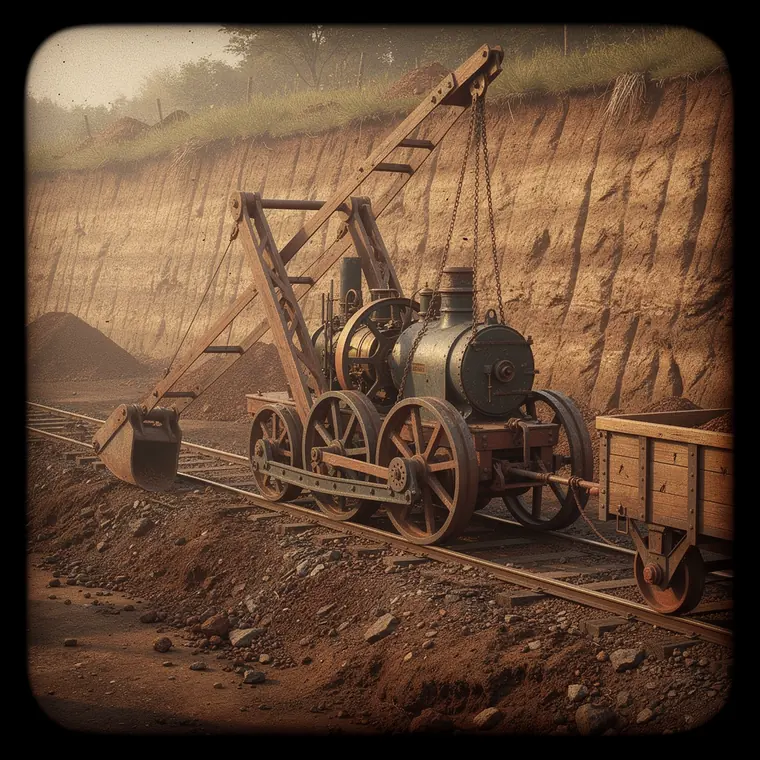
An early steam shovel standing on flanged iron wheels on temporary rails laid along the floor of a raw cutting, the boiler and engine mounted on the rail chassis at one end, a short heavy timber boom at the other end with a dipper arm and iron bucket at its tip, chain hoists running over the boom head to the bucket, the boom swinging only part way to either side, dipper arm swung out over spoil wagons on an adjacent track, embankment walls of fresh clay rising on either side.
- What it was used for
- The machine dug cuttings for railways. William Smith Otis of Philadelphia built the first machine in 1835; in 1836 he worked with Joseph Harrison on a prototype and a pre-production model. They were used on the Boston and Providence Railroad and on the Western Railroad in Massachusetts. Patent number 1,089 of 24 February 1839 was entitled "Crane-Excavator for Excavating and Removing Earth". The machine stood on rails, swung a wooden jib, and needed men on the ground hauling ropes to slew it and to trip the bucket.
- What was new
- What was new was not powered digging but that digging, lifting and slewing were done by one engine in one cycle: the movements of a man with a shovel, in iron. Against the later power shovel it lacked full rotation; the jib swung through roughly a half-circle. The barb comes afterwards. Otis died of fever in November 1839, less than nine months after the patent, aged 26. Relatives and partners kept the rights; an uncle by marriage obtained a seven-year extension in the widow's name before it expired. Still the machine barely sold: immigrant labourers with shovels were cheaper. Only in the 1870s did the steam shovel come into its own.
Further reading
- Transportation History: 1839 - A U.S. Patent is Granted for a Groundbreaking Machine (Patent 1089, 24. Februar 1839, Western Railroad)
- Mining Foundation of the Southwest: William Otis (Patentverlängerung, billige Arbeitskraft)
- AEM Hall of Fame: William Smith Otis (Prototyp 1835, Tod 1839 mit 26, Patent in der Hand von Angehörigen)