Steam Fire Engine
1829 · Fire Pump · Work 108 of 1,871
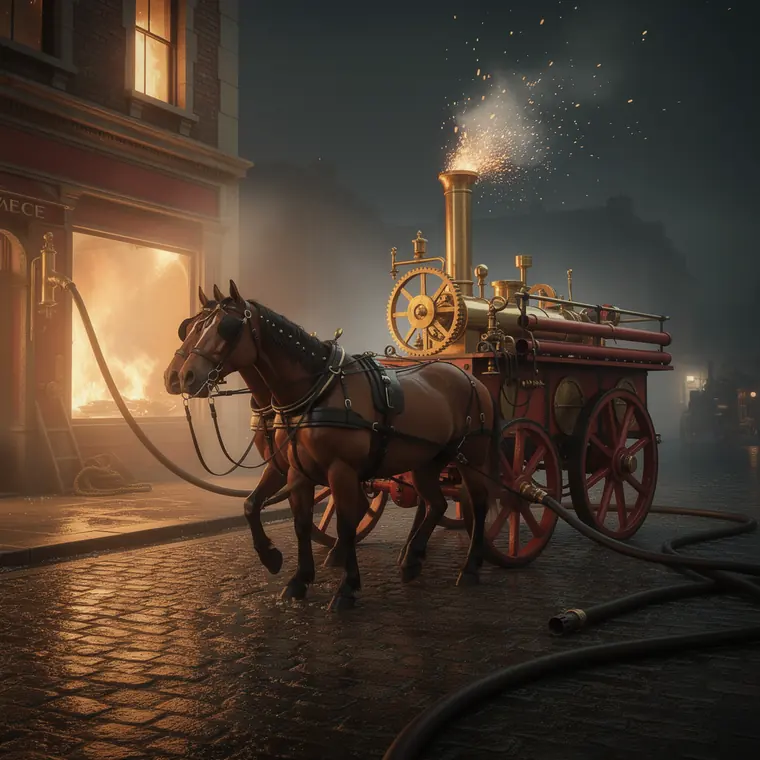
A horse-drawn steam fire engine at work in a city street, vertical boiler chimney streaming sparks, hoses snaking across wet cobbles toward a burning frontage.
- What it was used for
- In 1829 John Braithwaite and John Ericsson built a fire engine in London with its own steam engine. It worked at the English Opera House and Argyll Rooms fires of 1830 and at the burning of the Houses of Parliament in 1834; Braithwaite received 500 pounds for saving a distillery. According to his obituary it got up steam in twenty to thirty minutes. The fire brigade of the day saw a competitor and obstructed it in action, among other things by playing cold water on its boiler. In the end the machine was destroyed by a London mob. He built four larger engines, one for the municipality of Berlin and one for Liverpool, and gave up in 1833.
- What was new
- What was new was endurance: the manual engine depended on relays of men at the handles, who tired; the steam engine held its jet as long as the fire under the boiler was fed. The only performance figure that could be traced comes from Braithwaite's obituary and gives two tons of water a minute; that is the maker's own side of the story, and no independent measurement could be found. The barb is in the calendar: London's fire service took its first land steam fire engine into service in 1860, thirty-one years after this machine.
Further reading
- Grace's Guide: John Braithwaite (Nachruf: Dampf in 20 bis 30 Minuten, zwei Tonnen Wasser je Minute, Behinderung durch andere Spritzen, Zerstörung durch eine Menge, Maschinen nach Berlin und Liverpool)
- Science Museum Group Collection: 'Sutherland' steam fire engine (1863); die Objektseite nennt 1860 als Jahr der ersten Landdampfspritze der London Fire Engine Establishment
- SteamIndex: John Braithwaite and John Ericsson