Steam Printing Press
1814 · Printing Press · Work 109 of 1,871
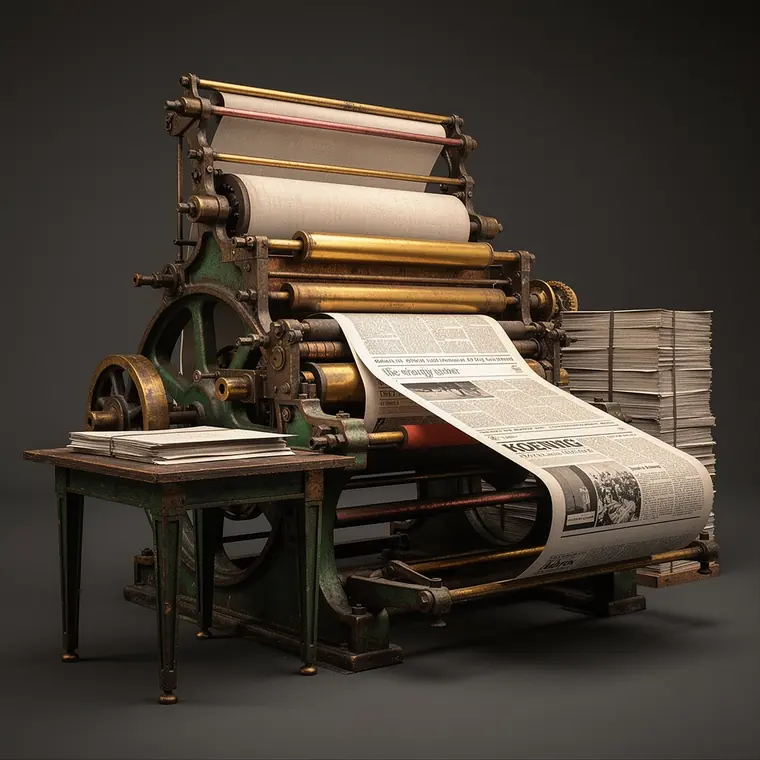
A Koenig steam-driven cylinder printing press, sheets fed in at one end and delivered printed at the other, inking rollers above the type bed, newspaper quires stacked alongside.
- What it was used for
- On the night of 29 November 1814 The Times of London printed its issue for the first time on a steam-driven machine by Friedrich Koenig and Andreas Bauer. John Walter the younger had two machines set up in a neighbouring building, because the pressmen had sworn to destroy any machine that threatened their work. That night he held them off with word that news was expected from the Continent, then came out to them with the paper already printed. The paper itself wrote that it presented to the public "the practical result of the greatest improvement connected with printing, since the discovery of the art itself", and gave the figure: eleven hundred sheets in an hour.
- What was new
- Eleven hundred sheets an hour against about 250 on the Stanhope press, more than four times as many, and without the muscle work at the hand press. What was new was not steam alone but the arrangement: cylinders carried the sheet over the flat forme, and rollers inked it where balls had been dabbed on by hand. Nor was it a jump from nothing, but an advance on Koenig's own earlier machine, which managed about 800 sheets an hour. The barb: Koenig got little out of it. Quarrels with his backer Thomas Bensley blocked series production in England; in 1817 he went back to Germany, bought the secularised monastery of Oberzell near Wuerzburg and founded there with Bauer the firm that builds printing presses to this day.
Further reading
- Age of Revolution: König and Bauer's steam powered printing press (29. November 1814, heimliche Aufstellung, mehr als viermal so schnell wie die Stanhope-Presse)
- Koenig & Bauer: On the 250th Birthday of Friedrich Koenig (800 Bogen der älteren Maschine, Streit mit Bensley, Oberzell 1817)
- History of Information: John Walter Secretly Prints the First Issue of The Times (Leistung der Stanhope-Presse, Belegstellen Brock und Meadows)
- Linda Hall Library: Scientist of the Day - Friedrich Koenig
- The Times, 29. November 1814, Leitartikel; Volltext bei Charles Knight, The Old Printer and the Modern Press (1864)