Steam Loom
1840 · Automatic Loom · Work 110 of 1,871
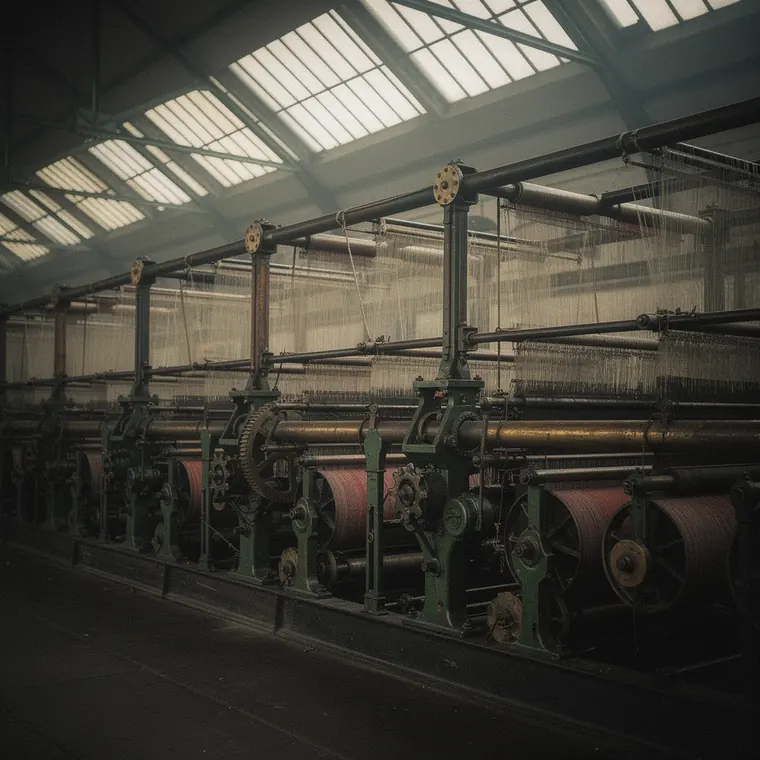
Rows of power looms in a weaving shed, overhead line shafting and belts driving every frame, north-light roof glazing above, warp threads catching the light.
- What it was used for
- The power loom stood in weaving sheds, belted to a line shaft turned by a steam engine. Around 1840 it was settled who would do the weaving in cotton. The series Robert C. Allen compiles from Baines, Timmins and Wood gives for 1820 about 14,000 power looms and an estimated 240,000 handloom weavers; for 1835 about 109,000 looms and 188,000 weavers; for 1845 about 225,000 looms and 60,000 weavers; for 1850, 249,627 looms and 43,000 weavers. The figures vary between sources: a Cambridge atlas gives 12,150 looms for 1820 and 85,000 for 1833. The weaver numbers are estimates.
- What was new
- What was new about the loom of 1840 was not the principle - Cartwright patented that in 1785 - but that it finally paid, and so turned the trade over within one generation. In 1820 about a tenth of the cloth came from power looms; by 1845 some 95 per cent. The barb stands in the same study: the handloom weavers, who in the boom years around 1800 earned considerably more than ordinary labourers, lost first the wage and then the work; by mid-century a building labourer earned three to four times a hand weaver's wage. Of an estimated 240,000 in 1820, 43,000 were left in 1850 and about 10,000 in 1860. Nobody was retrained.
Further reading
- Robert C. Allen, The Hand-Loom Weaver and the Power Loom: A Schumpeterian Perspective (Arbeitspapier, NYU Abu Dhabi 2017), Tabelle 1 nach Baines, Timmins und Wood
- Cambridge Group for the History of Population and Social Structure: The Wool and Cotton Textile Industries in England and Wales up to 1850