Parsons Steam Turbine
1884 · Steam Turbine · Work 111 of 1,871
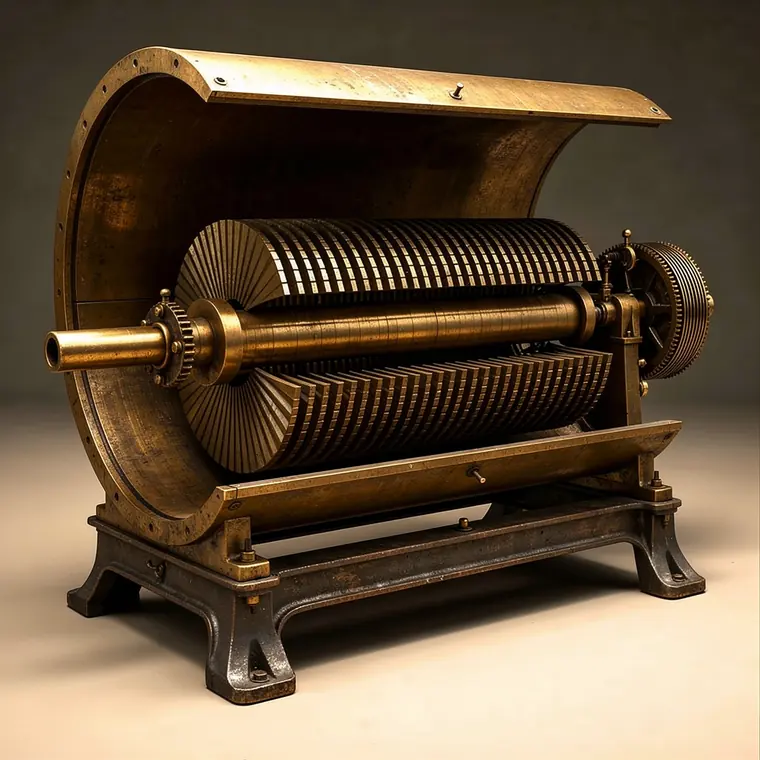
A Parsons steam turbine opened along its axis: a long cylindrical rotor shaft on a cast iron bedplate carrying many close-set rings of small straight blades, the rings increasing in size stage by stage along the rotor, the steam admitted at the middle of the length and flowing outward in both directions through mirror-image sets of blades, matching rings of fixed blades on the inside of the cylindrical casing, the casing halves lifted clear on either side to show the rotor within, a dynamo coupled on the same shaft at one end, a compact enclosed machine of steel and brass.
- What it was used for
- Electric light on ships. From 1884 Parsons was a junior partner at Clarke, Chapman & Co. in Gateshead, a marine equipment maker; the first turbine-and-dynamo set delivered 7.5 kW and replaced the reciprocating engine as the drive for shipboard generators. By 1888 about 200 such sets were in service, mainly for ship lighting. When Parsons left in 1889 to found his own firm at Heaton, Clarke, Chapman kept the turbine patents. For the next five years he built radial-flow turbines to work around his own design; only in 1894 did the rights return to him.
- What was new
- Not the first steam turbine: de Laval was at the same time driving cream separators with small reaction turbines at about 40,000 rpm. What was new was the handling of speed. Parsons split the pressure drop of the steam across many blade rings in series, so each stage took only a small part of it and blade tip speed stayed moderate. Steam entered at the middle of the shaft and expanded symmetrically to both ends, cancelling axial thrust. He built the matching dynamo himself: turbine and generator sat on one shaft without gearing, at 18,000 rpm.
Further reading
- Charles Algernon Parsons – Science Museum Group Collection
- Parsons' steam turbine generator, 1884 – Science Museum Group Collection
- Forward Thinkers: Sir Charles Parsons – Institution of Mechanical Engineers
- Sir Charles Parsons and the birth of the steam turbine – The Maritime Foundation
- Parsons Turbines: Early Examples – Grace's Guide
- History of steam turbine technology – Encyclopaedia Britannica