Rocket
1829 · Stephenson Locomotive · Work 112 of 1,871
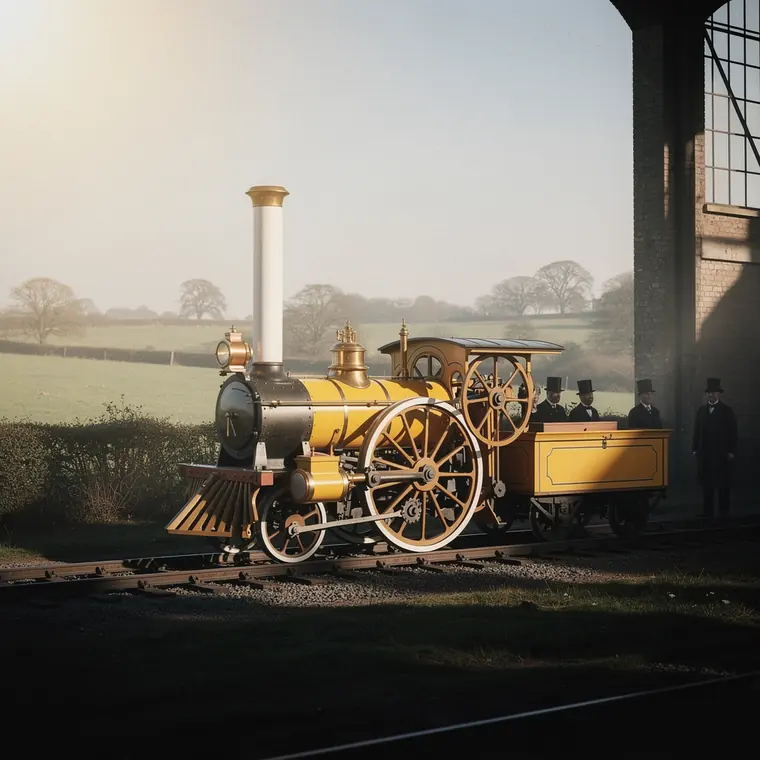
Stephenson's Rocket at the Rainhill trials, seen from the side: the two driving wheels at the front under the tall chimney are enormous, taller than a man's shoulder, the two wheels at the rear under the firebox are tiny, the engine visibly tips down towards its small rear wheels, two cylinders mounted high on the boiler sides and inclined steeply down to the big front wheels, a tall thin chimney at the very front, the cylindrical boiler behind it with a separate firebox at the rear, painted yellow and black, a small four-wheeled tender with a water barrel coupled behind, judges in top hats with pocket watches standing beside the track.
- What it was used for
- Rocket was built to order for the Liverpool & Manchester Railway. It won the Rainhill contest in October 1829 and secured Robert Stephenson & Co. the line's locomotive order. On opening day, 15 September 1830, it ran in the procession and struck MP William Huskisson at Parkside; he died that evening. By then it was already outdated: the first Planet was finished in the autumn of 1830, and Rocket was put on secondary duties and rebuilt several times. The L&M sold it in 1836 to Lord Carlisle, whose steward John Ramshay arranged the purchase; from April 1837 it hauled coal trains on the Brampton Railway in Cumberland, proved too light for the work and was laid aside in 1840.
- What was new
- What was new was not the locomotive but the boiler: instead of a single flue, 25 tubes of three inches diameter carried the hot gases through the barrel, with a separate water-jacketed copper firebox behind. The far larger heating surface made steam as fast as the engine used it at speed. The blast pipe turned the exhaust up the chimney and drew the fire, so the engine regulated itself. The tubular boiler was suggested by Henry Booth, treasurer of the L&M. Priority is disputed: Marc Séguin held a French patent of 12 December 1827 and was building a tubular-boiler locomotive in parallel in 1829; sources disagree on which of the two steamed first.
Further reading
- Michael Bailey, 'Rocket's engineering excellence', Science and Industry Museum, 25.10.2018
- Stephenson's Rocket, Rainhill and the rise of the locomotive – National Railway Museum
- Rocket locomotive, Objekt 1862-5 – Science Museum Group Collection
- 'Opening of the Liverpool and Manchester Railway', The Spectator, 18.09.1830 (Zeitgenossenbericht)
- Industrial Railway Society, Industrial Railway Record 51 – ROCKET auf Lord Carlisle's Railway
- Marc Séguin – Grace's Guide