Gurney Steam Carriage
1820 · Road Steamer · Work 113 of 1,871
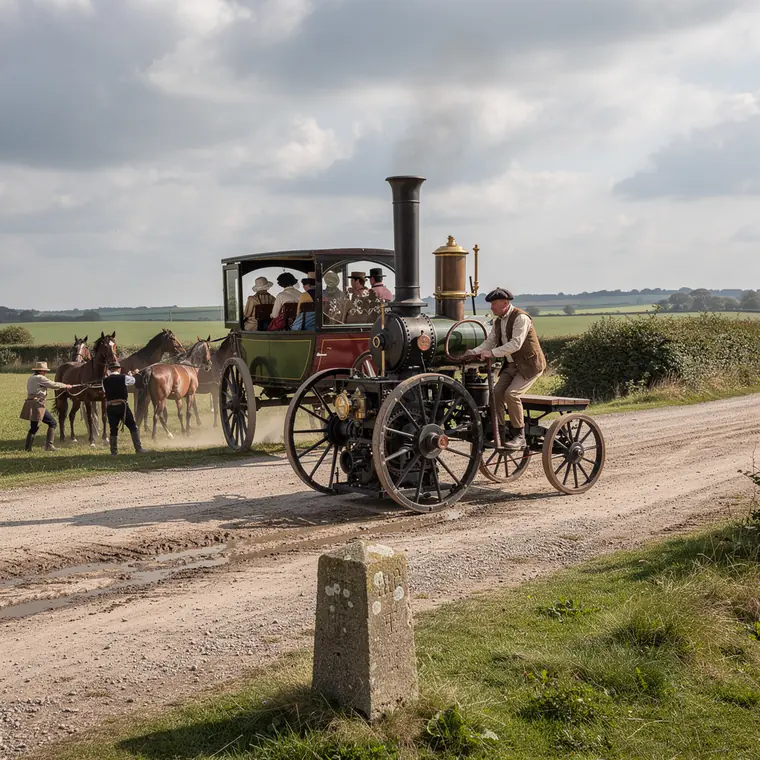
A Gurney steam carriage on a turnpike road, a stage-coach body on tall spoked wooden wheels with the boiler at the rear and the engine slung beneath the body, a pair of smaller steered pilot wheels ahead of the body, the road an unpaved surface of rutted gravel and earth without any asphalt, grass verges and hedges along the road, startled horses at the verge, milestone in the foreground.
- What it was used for
- The carriages were not run by Gurney himself but by Sir Charles Dance. Through four months of 1831 he put Gurney steam carriages into scheduled service between Gloucester and Cheltenham: to a timetable, four times a day, carrying fare-paying passengers. In that time, according to a petition by Gurney laid before the Commons in 1834, they had covered some 4,000 miles and carried about 3,000 people, averaging ten miles an hour. What ended the service was no mechanical failure — the axle that broke in June 1831 broke on gravel heaped on the road on purpose — but road tolls: at the turnpike gates a steam carriage paid ten to twelve times what a four-horse coach paid. A parliamentary select committee came out in favour of steam carriages in 1831; it made no difference. Gurney lost his fortune and later petitioned Parliament for compensation.
- What was new
- It was not the first steam vehicle: Cugnot ran in 1769, Trevithick in 1801 and 1803. What was new is what this carriage could do. A tubular boiler gave enough steam at low weight, and a steam jet in the chimney drew the fire instead of relying on natural draught — so the carriage held its power over hours, not just over a demonstration run. That turned the experiment into daily timetabled working on a public highway. Gurney was not alone in this: in 1831 Walter Hancock was running his "Infant" between Stratford and the City of London at the same time. Authorship of the steam jet is disputed; it has also been credited to Trevithick, Timothy Hackworth and George Stephenson.
Further reading
- Steam Carriages, HC Deb 29 April 1834 (Sir William Molesworth), Hansard
- Report from the Select Committee on Steam Carriages (1831), Aussage Goldsworthy Gurney
- Goldsworthy Gurney – Grace's Guide
- Goldsworthy Gurney: Steam Carriages – Grace's Guide
- Walter Hancock – Science Museum Group Collection
- Gurney, Goldsworthy – Dictionary of National Biography (1890), Wikisource