Paddle Wheeler
1810 · River Steamer · Work 114 of 1,871
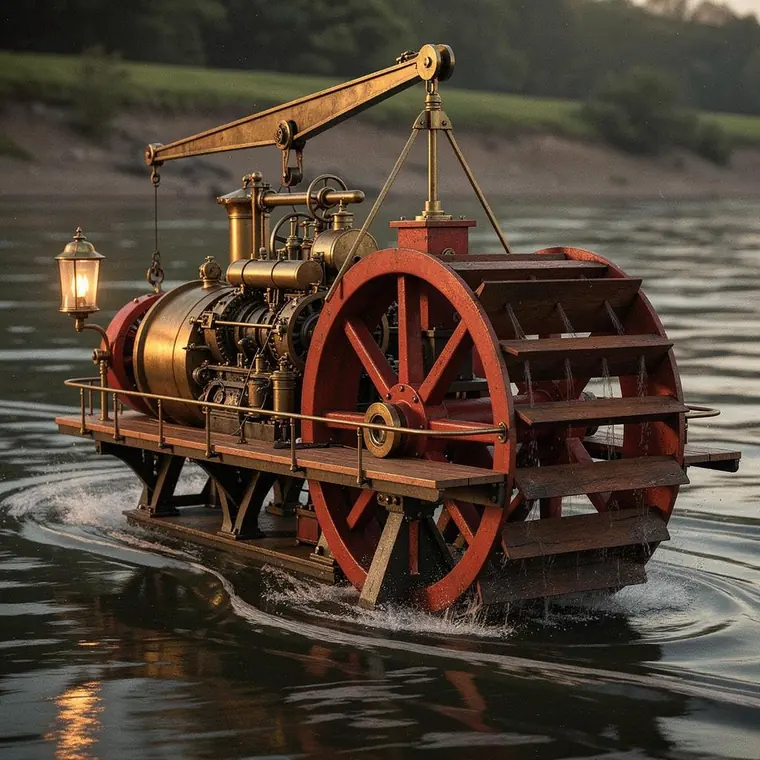
The engine and paddle wheel of a river steamboat in cutaway, walking beam rocking above the deck, buckets of the wheel entering the water, riverbank sliding past.
- What it was used for
- Around 1810 the paddle steamer was in regular service a river and estuary carrier, not a seagoing ship. Fulton's North River Steam Boat ran New York–Albany from 4 September 1807; the advertisement in the American Citizen of 2 September 1807 gave a 6 a.m. departure and fixed rates, seven dollars to Albany in 36 hours. A sloop covered the same water in about 24 hours with a fair wind, in days against it: the steamer was not faster, but it was predictable. On the Clyde, Henry Bell's Comet ran three times a week each way from August 1812, Glasgow–Greenock–Helensburgh, four shillings best cabin and three shillings second.
- What was new
- Steam propulsion itself was not new: Jouffroy d'Abbans ran in 1783, John Fitch operated a scheduled Delaware service from 1790, Symington's Charlotte Dundas towed barges in 1803. What was new was operation that held up — season after season upstream against the current, independent of the wind, to a published timetable and fare — where Fitch's Delaware line had folded for want of passengers. The barb: that same traffic technology was locked up by law in New York. State acts gave Livingston and Fulton exclusive steam navigation; the act of 9 April 1811 allowed seizure of rivals' boats, and the Stevens ferry to Hoboken was pushed out in 1813. The waters were opened only by Gibbons v. Ogden on 2 March 1824.
Further reading
- Battle of the Newspapers – Steamboats on the Hudson (New York State Library)
- Full Steam Ahead (Hudson River Valley Institute, Marist College)
- The Hudson River Sloop (Hudson River Maritime Museum)
- Gibbons v. Ogden, 22 U.S. 1 (1824), Syllabus (Cornell LII)
- PS Comet – Grace's Guide
- Steamboat Innovation – The Stevens Family (Hoboken Historical Museum)
- John Fitch's Steamboat, Historical Marker (ExplorePAhistory / PHMC)