Steam Donkey
1880 · Forestry · Work 115 of 1,871
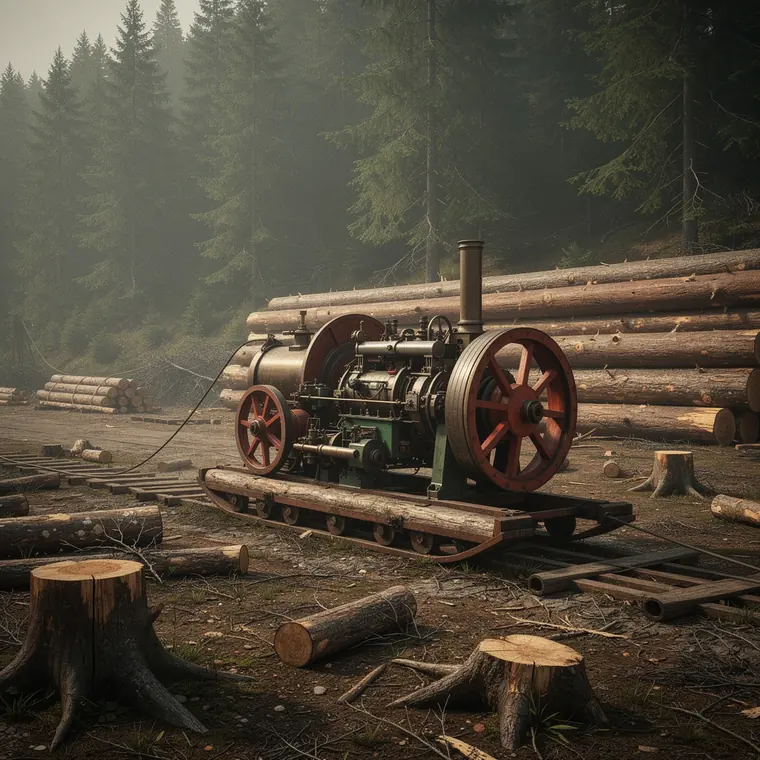
A steam donkey winch anchored on a log sled in a clearing, cable running out through the stumps, felled giants stacked behind, forest wall rising beyond.
- What it was used for
- John Dolbeer, a partner in the Dolbeer & Carson Lumber Company of Eureka, California, first tried the machine in the redwood cuts of Humboldt County in 1881. A boiler on skids drove a horizontal rope spool; a manila line dragged felled logs across the ground to the landing or the logging railroad. It displaced the ox teams — an estimated twenty animals and more per team — that had until then skidded logs over corduroy roads. From California it spread to the Douglas-fir cuts of Oregon, Washington and British Columbia; by 1900 Humboldt local history counted 293 steam donkeys in Washington, 61 in California, 35 in Oregon. Of the old-growth redwood that once covered some two million acres, about four percent still stands.
- What was new
- Steam winches were not new; "donkey engine" was a shipboard term, and hoisting engines had long worked shipyards and building sites. Dolbeer's US patent 256,553 ("Logging-Engine", filed 28 February 1882, granted 18 April 1882) describes two things no machine could do in the cut before. First, vertical guide rollers feed the rope onto the spool so that "all the logs within a considerable distance from the machine may be hauled in any direction and to any point without moving the machine from its station" — an ox team had to go to every log. Second, when it did have to move: "the engine may move itself to any desired position".
Further reading
- John Dolbeer, Logging-Engine, US Patent 256,553 (Originalpatent)
- Donkey Engine – The Oregon Encyclopedia (Oregon Historical Society)
- Coast Redwood – U.S. National Park Service
- Hartley, Redwood Forest Conservation, USDA Forest Service PSW-GTR-238
- Humboldt History (Nachdruck The Humboldt Historian), Lost Coast Outpost