Aeolipile
50 · Hero of Alexandria · Work 116 of 1,871
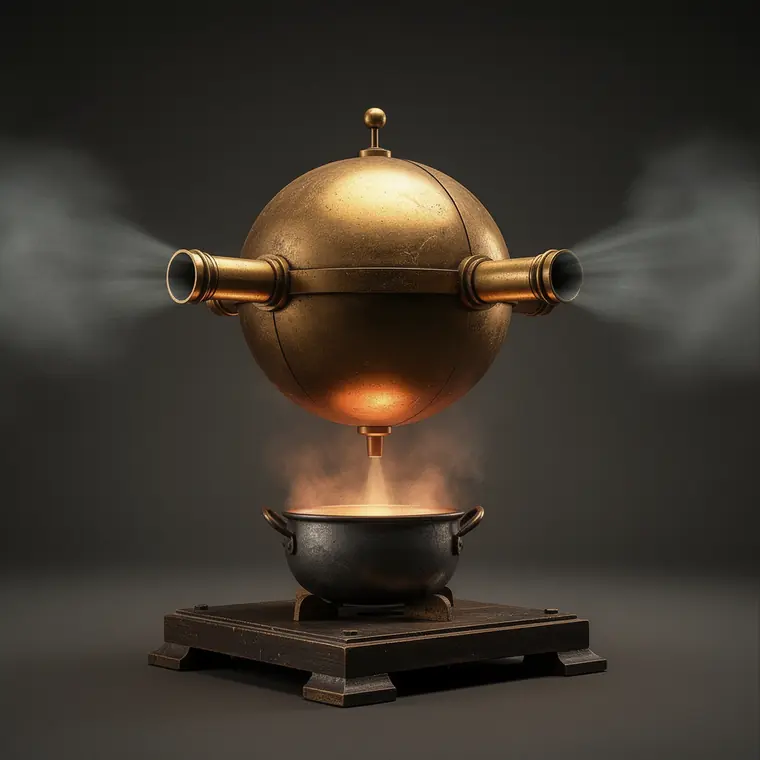
The aeolipile of Hero of Alexandria, a hollow bronze sphere spinning on its axle above a small cauldron, two bent nozzles venting steam, the first machine ever turned by steam.
- What it was used for
- It never did any work. Woodcroft's translation of the Pneumatics lists 78 devices. No. 50 sits among temple doors that open by themselves when a fire is lit on the altar (Nos. 37 and 38), a sacrificial vessel that releases water only after a five-drachm coin is dropped in (No. 21), and singing birds (No. 15). It was a teaching and display piece about the force of heated air and steam. That is where the barb sits: it showed the recoil of steam and led nowhere for some 1,600 years, until Savery's patent of 1698 and Newcomen's engine of 1712. Not because nobody understood it, but because without a pressure boiler and the metalworking such a boiler needs, there was nothing to do with it.
- What was new
- What was new was not the object itself. Vitruvius already describes "aeolipilae aereae cavae" in De architectura I.6.2: hollow bronze balls with a narrow opening, filled with water and set by a fire; once the water boils, a violent wind comes out. His work was written after 27 BC, so before Hero. Vitruvius's balls only blow. Hero fitted the ball with two bent tubes pointing in opposite directions, so that the escaping steam turned it: the device showed recoil as a drive. Hero's dates are uncertain; the common range of about AD 10 to 70 rests on a lunar eclipse usually placed on 13 March AD 62, whose evidential value is contested in the scholarship.
Further reading
- Hero of Alexandria, The Pneumatics, übers. Bennet Woodcroft (1851), Nr. 50 'The Steam-Engine'
- Woodcroft (1851), Index der Abschnitte 1 bis 78
- Vitruvius, De architectura I.6.2, lateinischer Text (LacusCurtius)
- Ramon Masià, 'On dating Hero of Alexandria', Archive for History of Exact Sciences (2015)
- Aeolipile – Smithsonian, National Museum of American History
- APS News: 'July 2, 1698: Thomas Savery Patents an Early Steam Engine'