Papin Digester
1679 · Steam Digester · Work 117 of 1,871
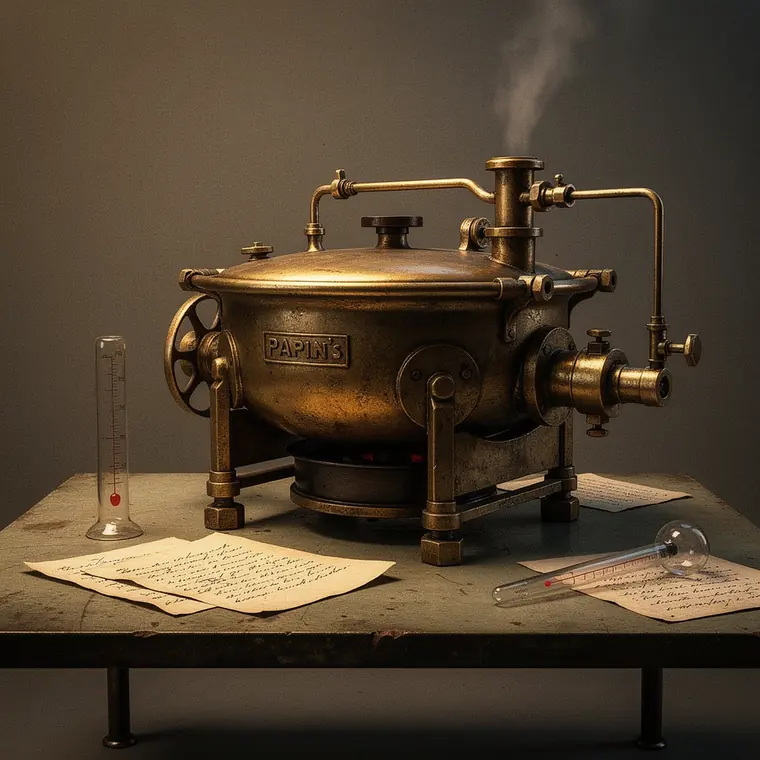
Papin's steam digester on a laboratory brazier, heavy bolted lid and the first safety valve weighted on its lever arm, notes and a thermometer on the table.
- What it was used for
- From 1675 Papin worked in London as Robert Boyle's assistant. His vessel was meant to break down bones, gristle and tendons under pressure, turning butchers' waste into broth and jelly. His 1681 book addresses cooks, confectioners, drink-makers, chemists, dyers and voyages at sea: discarded bones could give the English fleet "better and cheaper Victuals" against scurvy. On 12 April 1682 John Evelyn ate a supper cooked entirely in the digester with several Fellows of the Royal Society: beef bones "as soft as cheese", and a jelly he called the most delicious he had ever tasted. It was a supper with several Fellows, not a meeting of the Society; the poor-relief use so often cited is absent from Papin's book and appears only in the 18th century.
- What was new
- The digester held water liquid far above its ordinary boiling point. By his own records Papin worked at up to twelve times atmospheric pressure, breaking down bone, hartshorn and tortoiseshell; ivory yielded a clear jelly but stayed brittle; no open pot could do that. He could not measure the temperature, lacking a usable thermometer, so he counted the seconds a drop of water took to evaporate. The decisive part was the valve in the lid: a lever with a sliding weight, "much after the manner as a weight is hung upon an ordinary Roman balance or Stilyard". Papin presents it first as a pressure gauge; reading it as a safety valve came only later. The valve outlived the cooking pot.
Further reading
- Denys Papin, A New Digester or Engine for Softning Bones, London 1681 (Volltext, Wellcome/Internet Archive)
- The Diary of John Evelyn, Bd. II, Eintrag 12. April 1682 (Project Gutenberg)
- Rupert Baker, 'A plaque for Papin', The Royal Society Blog, 10.03.2020
- Marco Storni, 'Denis Papin's digester and its eighteenth-century European circulation', BJHS
- Papin's Digester for softening bones, Obj. 1860-15 – Science Museum Group Collection