Hornblower Compound
1781 · Two Cylinder Experiment · Work 119 of 1,871
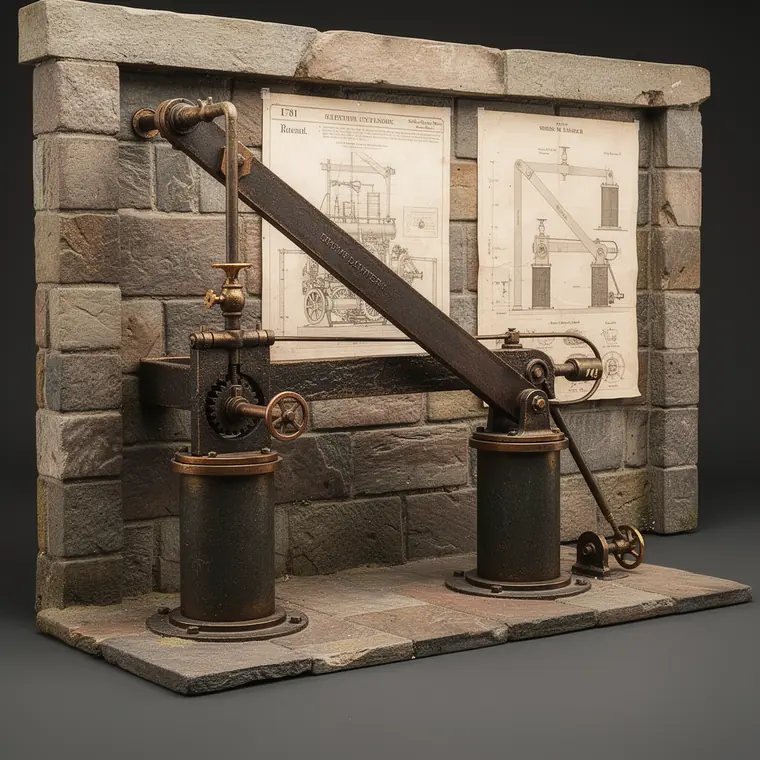
Hornblower's two-cylinder engine, a beam engine inside a stone engine house: a great rocking beam overhead pivoted on the wall, two upright cylinders of unequal diameter standing side by side beneath one end of the beam, both piston rods attached to the same arm of the beam, a pipe with a cock joining the bottom of the small cylinder to the top of the large one, the other end of the beam passing out through the wall to the pump rods, patent drawings pinned to the engine house wall behind.
- What it was used for
- Mine drainage: pumping in collieries and in the Cornish metal mines. Hornblower built the first engine with the Bristol founder Winwood at Middle Pit, Radstock colliery, Somerset; it was at work from August 1782, cylinders 19 and 24 inches. A second followed at Timsbury in 1784, a demonstration engine near Penryn in 1784–87, and one at Tincroft in Cornwall in 1791. The total is disputed: Boulton & Watt claimed in 1792 that only two had been erected - which Hornblower's own Case of the same year confirmed. In 1792 Hornblower's bid to extend his patent failed against Boulton & Watt's opposition; mine adventurers then paid Watt's premium rather than litigate.
- What was new
- What was new was the arrangement: steam works twice in succession, first in the small cylinder, then expanding into the large one (Patent No. 1298, 13 July 1781). It was meant to use the work of expansion more completely. Whether Hornblower was first is open: Robert Stuart in 1829 traced the two cylinders back to Dr N. D. Falck; what is documented is only that Hornblower patented compounding first and put it to work. The barb: he condensed the steam away from the working cylinder - by the patent against cooled metal surfaces, at Radstock in the base of the large cylinder. Boulton & Watt held that this infringed their condenser patent. Boulton & Watt sued Hornblower & Maberley — the brother Jabez Carter, not Jonathan — and in 1799 the Court of King's Bench upheld Watt's patent. At low pressure compounding gained little anyway; it only paid with high-pressure steam, from Woolf in 1804/05.
Further reading
- Hornblower, Compound Steam Engine, UK Patent No. 1298 (13.07.1781), transkribiert nach Coxe & Cooper, The Emporium of Arts and Sciences (1812)
- Hugh Torrens, 'The Winwoods of Bristol, Part One 1767–1788', BIAS Journal 13 (1980)
- Boulton and Watt Collection, MS 3147/5/1339/b: Hornblower's Engines, Radstock and Tincroft (Archives Hub)
- Jonathan Hornblower (1753–1815) – Grace's Guide
- Robert Stuart, A Descriptive History of the Steam Engine (1829), S. 141–144 (Auszug)
- Nuvolari u.a., 'The Emergence of High-Pressure Cornish Engines', in: Steam Power and Economic Growth (Springer 2023)
- Tincroft (1791, Hornblower and Winwood compound engine) – Explore Cornwall