Portsmouth Block Mills
1802 · First Steam Powered Mill · Work 120 of 1,871
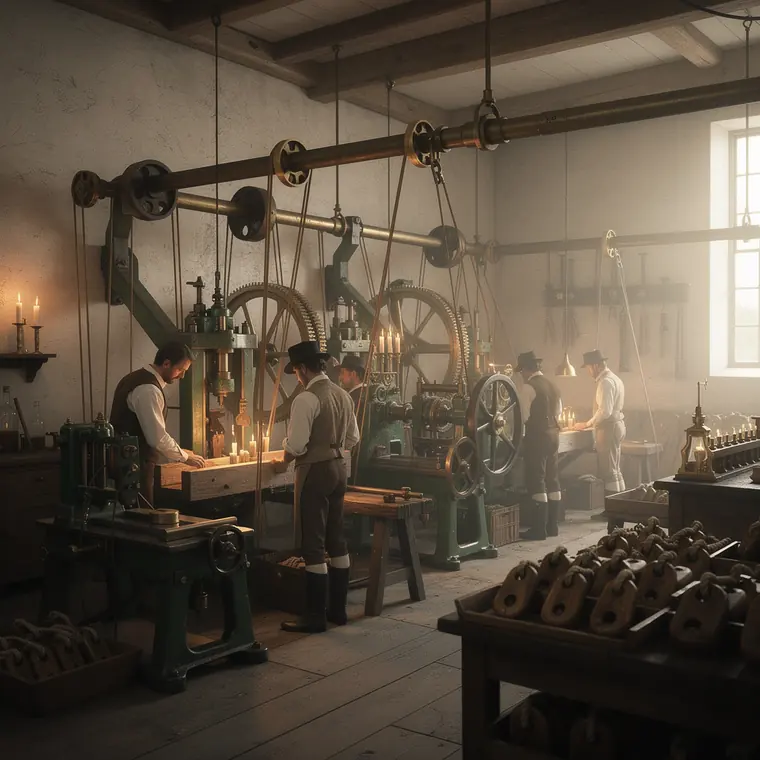
The block making machinery at Portsmouth, purpose-built machine tools in sequence along the shop, circular saws, mortising machines and shaping engines driven by flat leather belts from overhead pulleys and shafting, finished pulley blocks accumulating in trays, the first fully steam-powered factory, the long shop lit only by daylight through the rows of windows and by candles and oil lamps, plain plastered walls and timber beams overhead, the men in shirtsleeves, waistcoats and breeches.
- What it was used for
- The plant in the naval dockyard at Portsmouth made wooden blocks — the pulley blocks of the rigging — for Royal Navy ships. Until 1803 the Navy bought them almost entirely from Walter Taylor of Southampton, who had supplied since 1759 and was shipping over 100,000 blocks a year by the 1780s; the Navy's own production was being installed from 1802 and was already starting up in the year of Taylor's death, 1803. In 1808 the 45 machines there produced 130,000 blocks. The figure of ten unskilled men replacing 110 skilled blockmakers is reported by Historic England explicitly as a claim, not a verified count. The machines outlasted sail itself: block-making and repair work went on there, steadily diminishing, into the 1960s.
- What was new
- What was new was not the machine but the chain: 45 single-purpose machines, each doing one step, the workpiece passing from one to the next. Taylor in Southampton already had circular saws and steam power — but there the blockmaker's hand still held the dimension, here the jig and the machine setting held it, so unskilled hands turned out what had been skilled work. The Science Museum Group calls it the first purpose-designed and integrated system for quantity production in the world. Shortly before, Honoré Blanc had been working on interchangeable musket locks in France; his demonstration was in 1785 and he died in 1801. Eli Whitney's claim, by contrast, is largely unsupported: on surviving Whitney arms the parts were not even approximately interchangeable.
Further reading
- The Portsmouth Block Mills – The Start of a Revolution (Historic England Research Report)
- Portsmouth block-making machine, cross cut saw, 1805 – Science Museum Group Collection
- Original coaking machine, installed at Portsmouth – Science Museum Group Collection
- Businessman and inventor (Walter Taylor) – Southampton Stories, Southampton City Council
- Peter Baida, 'Eli Whitney's Other Talent', American Heritage 38:4 (1987)
- Eli Whitney and the Birth of the American Manufacturing System – Library of Congress