Chappe Telegraph
1793 · Optical Telegraph · Work 121 of 1,871
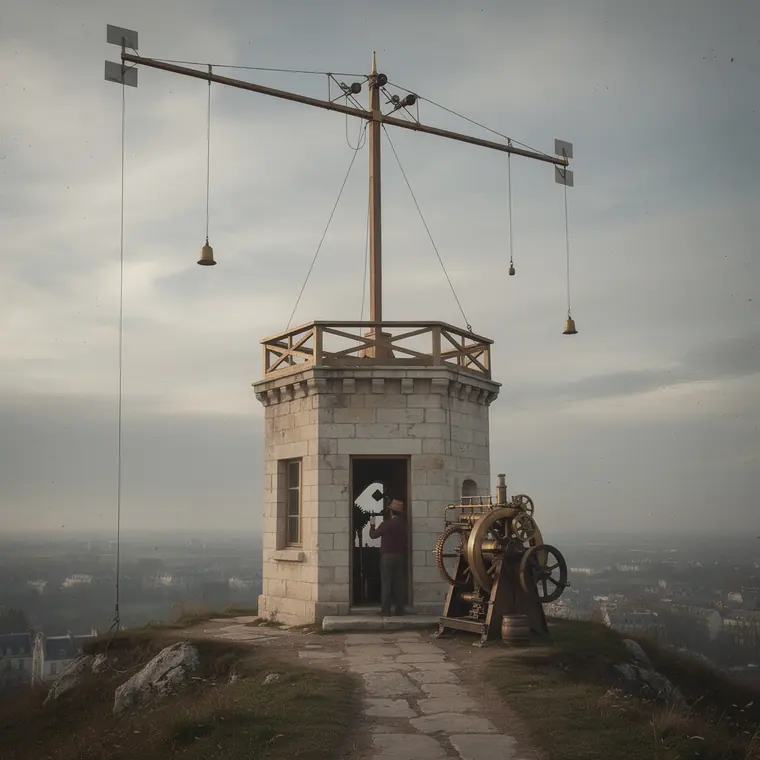
A Chappe semaphore telegraph on a hilltop station near Paris: a plain stone tower with a tall wooden mast rising from its roof, at the mast top a long horizontal regulator beam pivoted at its centre, and at each END of that beam a shorter jointed indicator wing, all three pieces of black-painted wood locked in one code position against the sky, counterweights on the arms, in the chamber below an operator working two control handles, a telescope at the window pointing toward the next station.
- What it was used for
- A state service, not a public one. On 4 August 1793 the Convention ordered the first line, Paris to Lille, to correspond with the northern armies: fifteen stations averaging 14.6 km apart, worked by keepers who relayed their neighbours' signals without understanding them. The codebook - from 1799 92 pages by 92 lines, 8,464 words and phrases in all - was held only by the line directors at the terminals. In 1838 a message went from Paris to Toulon in three hours instead of a week by post relay - but on average the line was usable only six hours a day. Between 1834 and 1836 two bankers bribed a station keeper to smuggle a private signal into government despatches; in court in 1837 they were sentenced only to pay the costs, because no law covered the case. The answer was the law of 2 May 1837: one month to one year in prison and 1,000 to 10,000 francs for anyone transmitting signals without authorisation.
- What was new
- The idea was not new. Robert Hooke had presented a code vocabulary and transmission rules to the Royal Society in 1684, printed only in 1726, and Chappe knew the text; Edelcrantz in Sweden in 1794 and Murray in England in 1796 were working on their own designs at almost the same time, so priority cannot be cleanly awarded. What was new was sustained operation: any message, not agreed in advance, drawn from a vocabulary of thousands of entries, could be relayed through dozens of intermediate posts, because two successive signals named a page and a line in the codebook. The keepers did not need to know the content, and were not allowed to.