Preussischer Telegraf
1832 · Optical Telegraph · Work 122 of 1,871
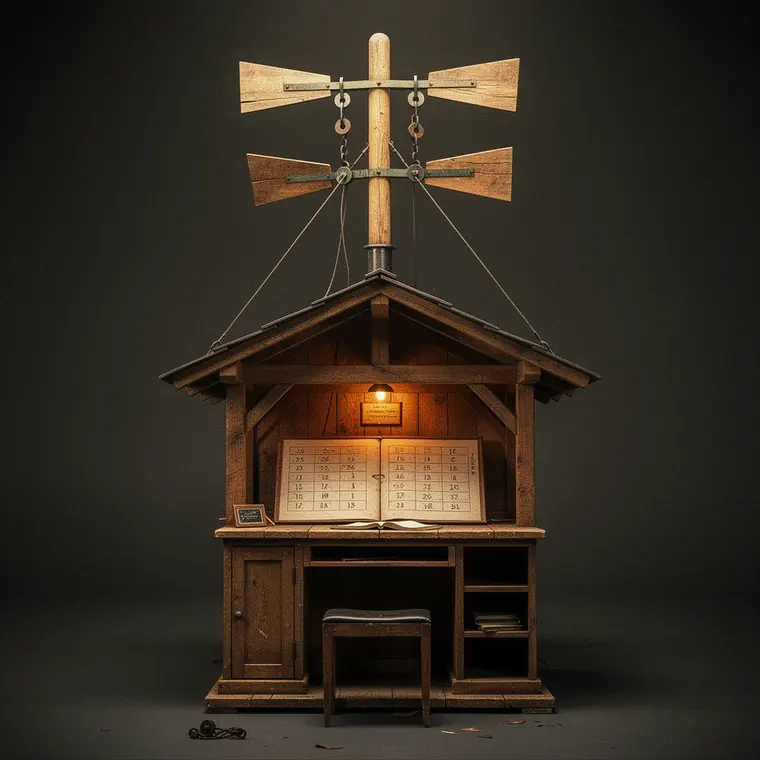
A Prussian optical telegraph station on the Berlin to Koblenz line, a tall mast carrying three crossbars with six rotating wooden wings, cable pulleys and a signal book desk in the timber cabin beneath.
- What it was used for
- Militarily organised, under the War Ministry, commanded by Telegraph Director O'Etzel; the telegraphists' corps numbered at most 200 men, two per station. Its purpose was a fast link to the western frontier after the revolutions of 1830. From 1833 there were 61 stations, from 1842 sixty-two, over some 587 km between Berlin and Koblenz; only state messages were carried, and only from persons to whom the King had granted the right. Throughput was about one and a half signs a minute, two to six despatches a day. When the Berlin merchants asked in 1835 to be allowed to send stock prices, a cabinet order refused. On 17 March 1848 the line carried an Interior Ministry message to Cologne saying that since the previous day all was quiet in Berlin; the next day the revolution broke out there.
- What was new
- Prussia was late: the Paris-Lille line had been working forty years earlier, and Pistor's apparatus followed a design by the Englishman Watson. The difference lay in signal density. Six arms on three levels displayed hundreds, tens and units at once, so a single setting carried a complete three-digit codebook number, where Chappe needed two successive signals per word; of 4,096 settings, 4,095 were usable. To this came a single Berlin time along the whole line: every three days a time-comparison signal ran from Berlin to Koblenz in just under a minute, against a good twenty minutes' difference in local solar time. The complete line then worked for only sixteen years, 1833 to 1849.
Further reading
- Optische Telegraphie - Die preussische Linie Berlin-Koblenz (Interessengemeinschaft Optische Telegraphie Station 4; nach Herbarth 1978 und Beyrer 1995)
- Hans-Jürgen Päch, Optische Telegrafie: Übertragungsmodalitäten und Inhalt der Depeschen (Stadt- und Landesbibliothek Potsdam, 2021)
- Die optische Telegraphenlinie (Verein Optische Telegraphie in Preussen e.V.)