Morse Register
1844 · Writing Telegraph · Work 128 of 1,871
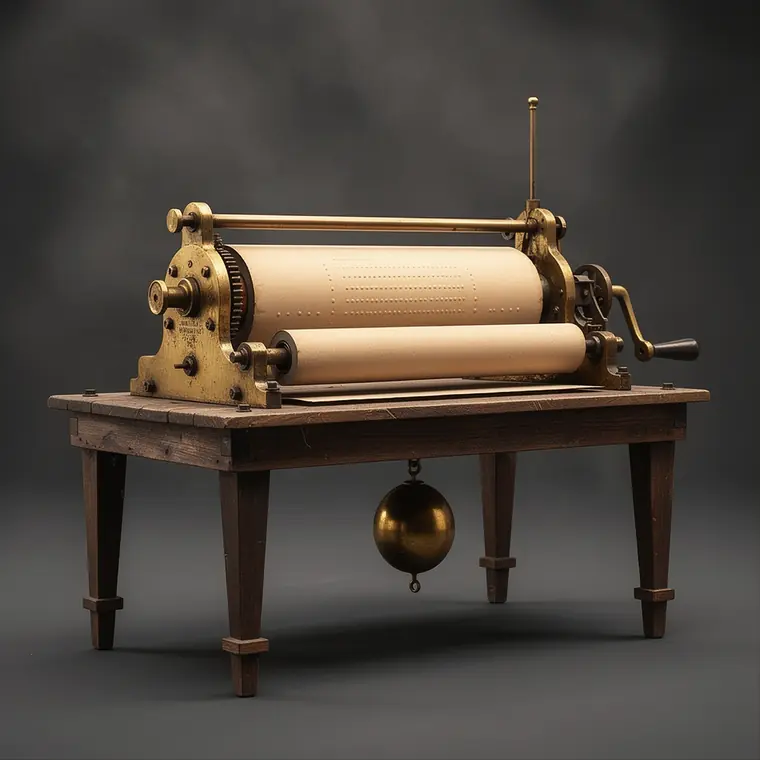
A Morse register in the Capitol committee room in Washington, a small brass mechanism on a wooden base: weight driven clockwork feeding a paper tape as narrow as a finger, like a long thin ribbon, between two small rollers and under the stylus of the armature lever, the embossed ribbon curling off the far side of the mechanism and coiling in loops on the table, an electromagnet beneath the lever, the tape completely blank apart from a line of tiny dents, the falling weight on its cord below the table edge, the paper nowhere wider than a finger.
- What it was used for
- The register was the recording receiver of the experimental Washington-Baltimore line, forty miles, built with the $30,000 Congress appropriated on 3 March 1843. On 24 May 1844 Morse sent the line What hath God wrought from the Supreme Court chamber in the Capitol to Alfred Vail at the Mount Clare depot in Baltimore; the Library of Congress holds the tape of that transmission. The first use that held up was political speed: the results of the Democratic convention of late May 1844 in Baltimore were known in Washington before a train could carry them; Silas Wright, offered the vice-presidency by telegraph, declined it the same way. As a paid service from 1845, at a quarter of a cent per character, the line took in $413.44 in its first six months and cost $3,244.99; in the first four days a single message was handed in, by a curious office-seeker.
- What was new
- A clockwork drew a paper strip past a stylus struck by the electromagnet: short pulses made dots, longer ones dashes, and the message lay there as a document. The needle telegraphs left nothing behind; that is exactly the difference the IEEE names when it credits Schilling's apparatus with visual indication only and Morse with graphic registration. Recording by the apparatus was not new, Steinheil's writing telegraph of 1837 already had the idea, and who is owed the code and the apparatus is open: the Smithsonian archives go no further than saying that some sources give Alfred Vail the major credit for the perfection of the instruments. And the recording for whose sake the code consisted of dots and dashes in the first place disappeared again: operators learned to read the clicks of the receiving magnet by ear, and the tape was abolished.
Further reading
- Samuel Morse's first telegraphic message, 24 May 1844 (Library of Congress, mcc.019)
- Telegraph: Early Postal Role (USPS Historian, 2015, PDF)
- Telegraph (Engineering and Technology History Wiki, IEEE)
- Vail Telegraph Collection, Finding Aid (Smithsonian Institution Archives, SIA.FARU7055)
- Shilling's Pioneering Contribution to Practical Telegraphy, 1828-1837 (IEEE Milestone, ETHW)
- Michael Geistbeck, Der Weltverkehr, 1887 (Steinheils Schreibtelegraf 1837)