Universal Stock Printer
1871 · Stock Ticker · Work 133 of 1,871
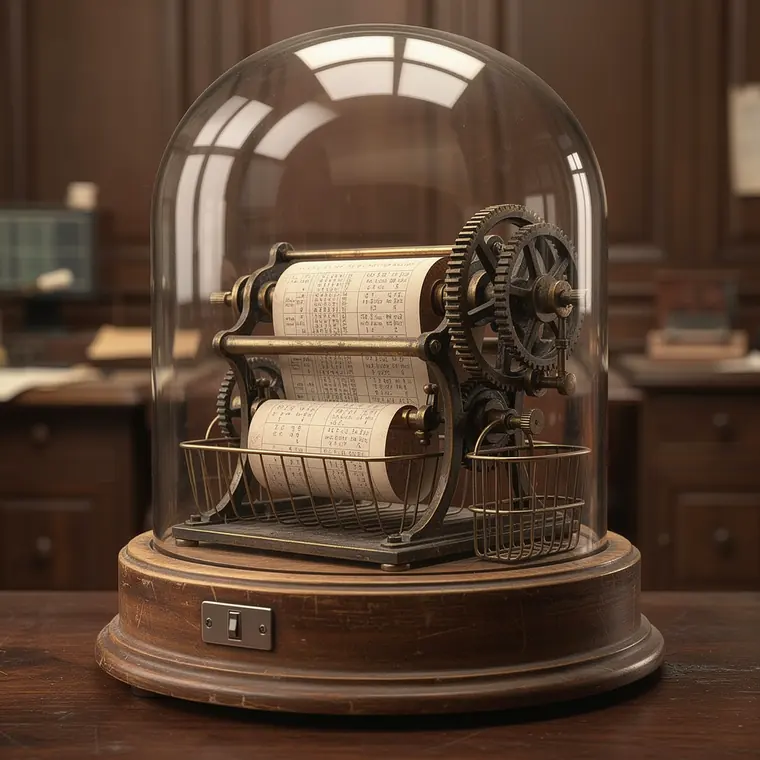
An Edison universal stock printer under its glass dome in a Wall Street broker office, a brass mechanism on a circular base, two type wheels striking a narrow tape that coils into a wire basket, a line switch fixed on the base, the office furnished with tall wooden desks, ledgers, gas brackets and a wall clock, panelled walls with framed prints, the brokers in frock coats and waistcoats.
- What it was used for
- A quotation printer in New York brokers' offices, run by the Gold and Stock Telegraph Company, which soon belonged to Western Union. The machine printed exchange prices continuously on paper tape. According to the Thomas A. Edison Papers at Rutgers, Edison developed the Universal Stock Printer in 1871 for that company; the IEEE's ETHW states that nearly 5,000 were sold between 1871 and 1874. The two patents for the unison-stop, US 131,344, and the type-wheel shift, US 131,342, were granted on 17 September 1872.
- What was new
- It was not the first stock printer: according to the Edison Papers, Edward Calahan devised that in 1867, also for Gold and Stock. What was new was fixing an operating fault at a distance. Printers on one line drifted out of step with the transmitter and had to be reset one by one on the spot. Edison's unison let the transmitting operator bring every machine on the line back into step at once, sending impulses that turned each machine's shaft until a peg in a screw-thread on the typewheel hit a stop. The barb: the instrument left the exchange after a few years but stayed in use until about 1960 for other purposes, among them the transmission of sports scores.