Dover Calais Cable
1851 · Submarine Cable · Work 134 of 1,871
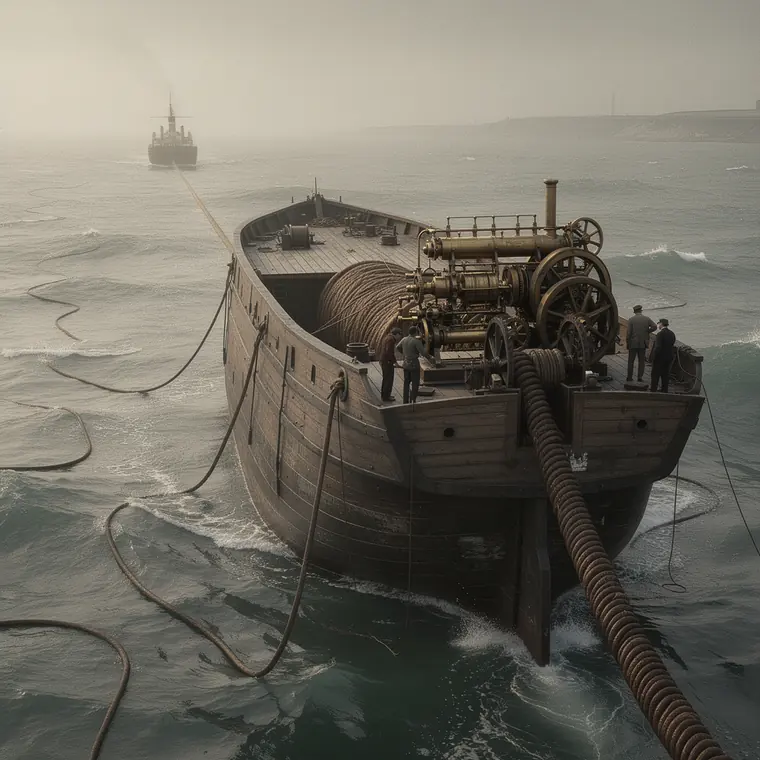
The hulk Blazer under tow in the Strait of Dover, a bluff old wooden ship's hull floating low in the water and pulled by a towline from a steamer ahead, the Dover to Calais submarine cable coiled in her hold, its gutta percha core armoured with spiral iron wires running aft over a large sheave at the stern and sinking into the sea astern, men at the stern watching the cable pay out, all machinery mounted inside the ship's hull, grey channel swell.
- What it was used for
- Telegraph traffic between London and the Continent, run by the Submarine Telegraph Company, to which both governments granted a ten-year monopoly. Newall & Co. made the cable in three weeks: four conductors, gutta-percha, ten iron armouring wires, about seven tons per mile. It was laid in September 1851 - sources give the 24th and the 25th - communication was, per atlantic-cable.com, "definitively established on the 17th October, 1851", and the office at 30 Cornhill opened to the public on 13 November 1851 at one in the afternoon. For 9,045 messages from London to Calais since 15 November 1851 the company had taken, per a report printed by Laurence Turnbull in 1853, 6,889 pounds 13 shillings 9 pence.
- What was new
- Against the attempt of 1850 this cable was armoured and had four cores. The 1850 cable was a single No. 14 copper wire in gutta-percha with no armouring at all, so light that it had to be sunk with lead weights at intervals; it did not hold. The barb lies in the explanation: the famous story of the fisherman who took a piece up in his trawl and showed it at Boulogne as a rare seaweed with gold in its centre comes apparently from W. H. Russell's book of 1865, and atlantic-cable.com calls it a myth. Willoughby Smith's account of 1891 on the same site instead records signals garbled by induction and retardation until the line was abandoned. Sources disagree on total weight: about 180 tons (atlantic-cable.com, consistent with its seven tons per mile) against about 20 tons in a Dover local history.
Further reading
- History of the Atlantic Cable & Undersea Communications: 1851 England-France Cable
- History of the Atlantic Cable & Undersea Communications: 1850 Dover-Calais Cable
- History of the Atlantic Cable & Undersea Communications: The 1850 & 1851 Dover-Calais Cables (Willoughby Smith account)
- The Dover Historian: Channel Submarine Telegraph and Telephone Cables