Siphon Recorder
1870 · Siphon Recorder · Work 138 of 1,871
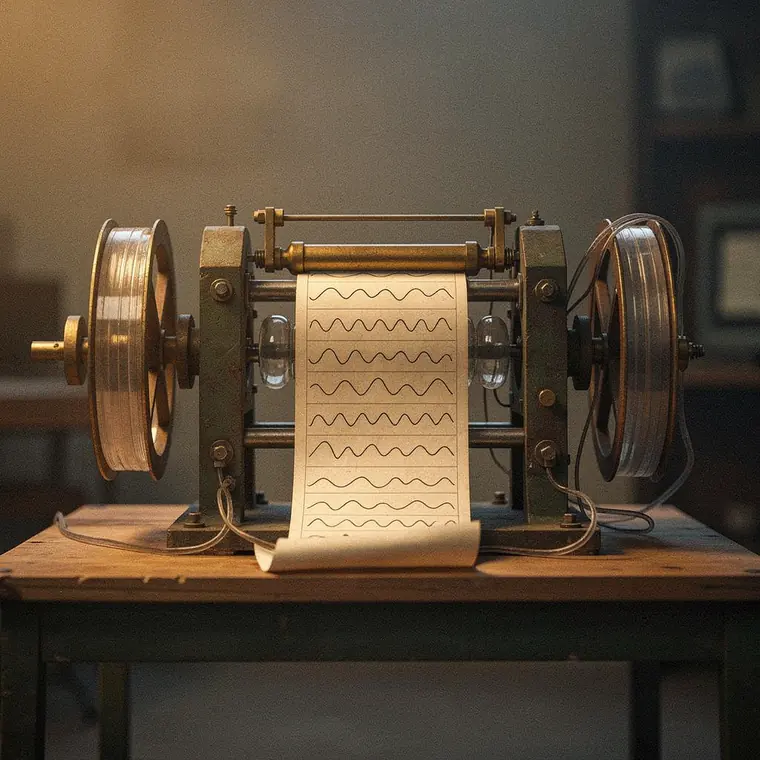
A Thomson siphon recorder in the cable station at Heart's Content, its fine glass siphon trailing wavy marks on a moving tape between the poles of a large horseshoe magnet, tape spools turning.
- What it was used for
- The receiving instrument in cable stations. The Science Museum holds an 1870 example built by James White & Co. of Glasgow, weighing 53 kg, used by the Eastern Telegraph Company in Egypt and later in India. Before it the mirror galvanometer needed two men, as atlantic-cable.com puts it: one with a steady eye to read and call off the signal, the other to write down the characters. The recorder drew a wavy line on moving paper; by the Telegraph Construction and Maintenance Company's early-twentieth-century treatise, a deflection above the zero line was a dot, one below a dash. The same treatise gives working speeds of about 45 words a minute, 100 to 120 with an improved vibrator, and under 20 on the longest cables.
- What was new
- What was new was not reading faint cable signals - Thomson's own mirror galvanometer had done that since 1858 - but the record: a paper slip produced without constant attendance, transcribed afterwards and filed against later queries. Patented in 1867, in general use in the 1870s; the first demonstration in England, per the Illustrated London News of 2 July 1870, was at John Pender's house in London on 23 June 1870, with signals from Bombay. The barb: Thomson advised the cable companies and at the same time patented what they then had to license; atlantic-cable.com names this policy as the reason he became a very wealthy man. For years the ink had to be electrified, and the treatise concedes that climatic effects added greatly to that method's disadvantages.
Further reading
- Bill Burns, Early Cable Instruments (History of the Atlantic Cable & Undersea Communications)
- Telegraph Construction and Maintenance Co., A Short Treatise on the Siphon Recorder
- Science Museum Group Collection: Siphon recorder, 1870 (Objekt 1923-233)
- Image Permanence Institute (RIT), DP3: The Siphon Recorder
- Illustrated London News, 2. Juli 1870 (Nachdruck atlantic-cable.com): Abend bei John Pender, Siphon Recorder erstmals in England vorgeführt