Bell Liquid Transmitter
1876 · Liquid Transmitter Telephone · Work 140 of 1,871
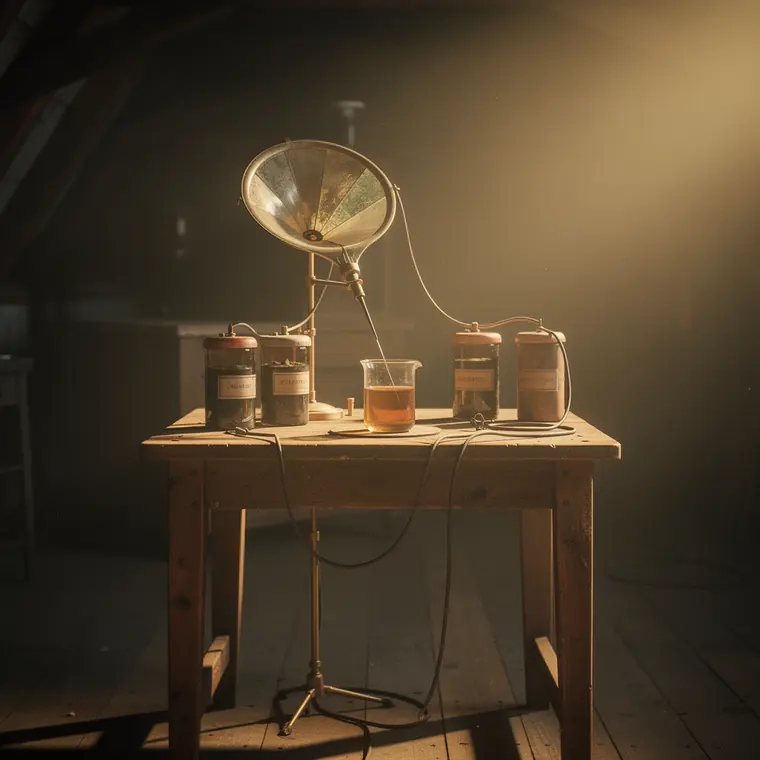
Bell's liquid transmitter on a workbench in the Exeter Place attic in Boston, a membrane with a needle dipping into a cup of acid, battery jars and a wire leading through to the next room.
- What it was used for
- A laboratory device in Bell's workshop at 5 Exeter Place, Boston. A wire dipped into a conducting liquid; when someone spoke into the cone, the varying depth of immersion changed the resistance and with it the current. On 10 March 1876 Thomas Watson, in the next room, understood the sentence the Library of Congress renders from Bell's notebook as "Mr. Watson — come here — I want to see you." The same day Bell wrote to his father of a great success. The order of events is worth noting: patent 174,465 was filed on 14 February 1876 and granted on 7 March - three days before the device first carried speech.
- What was new
- Instead of contact made and broken, a continuously varying current. Claim 4 of the patent claims "the method of producing undulations in a continuous voltaic circuit by gradually increasing and diminishing the resistance of the circuit, or by gradually increasing and diminishing the power of the battery, as set forth". Who reached it first is still disputed: per the Library of Congress, Elisha Gray filed a caveat the same day, hours later; the IEEE's ETHW calls his design a water transmitter, notes that Bell's lawyers had submitted the application that morning, and records that Bell "is sometimes accused of stealing Gray's idea". The barb is in the device itself: for public demonstrations and commercial use Bell employed, per ETHW, an improved magnetic transmitter, not Gray's water transmitter. The instrument that carried the famous sentence was dropped; the business grew on another.
Further reading
- Library of Congress Information Bulletin: Alexander Graham Bell notebook, 10 March 1876
- US-Patent 174.465 (Bell), eingereicht 14.02.1876, erteilt 07.03.1876
- Engineering and Technology History Wiki (IEEE): Elisha Gray
- Engineering and Technology History Wiki (IEEE): First Intelligible Voice Transmission over Electric Wire, 1876
- Library of Congress: Who is credited with inventing the telephone? (Bell 14.2.1876 als fünfter, Grays Caveat Stunden später als 39. Eintrag)