Siemens Hand Receiver
1878 · Magneto Telephone · Work 141 of 1,871
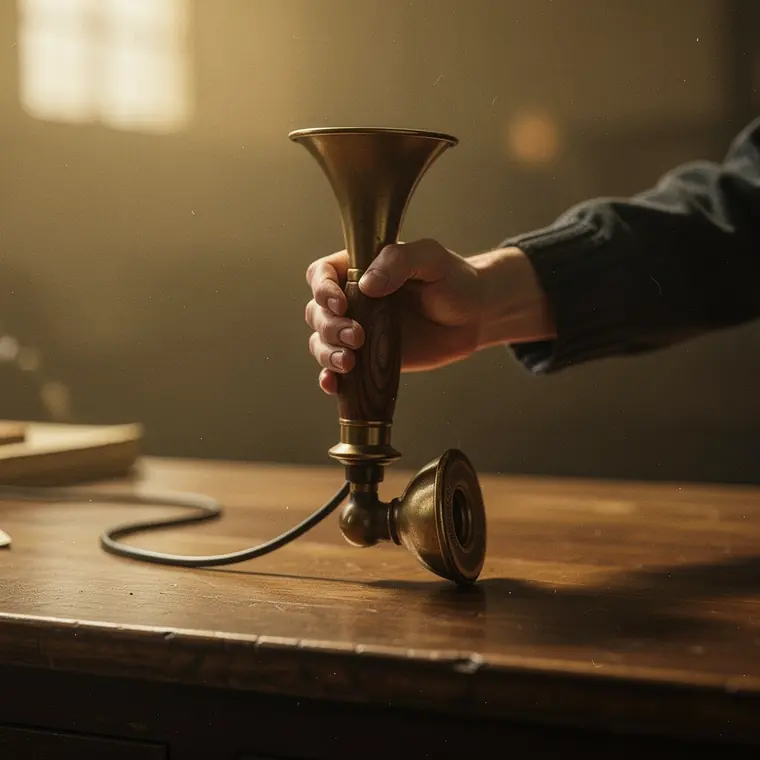
A Siemens horseshoe magnet telephone receiver held in one hand on a Berlin post office counter, its turned wooden handle enclosing the magnet limbs and coils under a flared shell earpiece.
- What it was used for
- The German Reichspost used the telephone inside its own service first: from November 1877 to pass telegrams by word of mouth between offices, regulated by a service instruction of 28 November 1877. The Siemens receiver was a dumbbell-shaped desk instrument of wood, leather and brass weighing about 800 grams. It had no microphone: the user held the leather-covered grip alternately to the ear and in front of the mouth. A battery and a bell for calling stood beside it. At a fee of at least 200 marks a year, a connection stayed with banks, firms and well-off private customers.
- What was new
- What was new was loudness, not the principle. Eduard Zetzsche wrote in the Polytechnisches Journal in 1879 that the Siemens instruments stood out through their considerable strength of tone and could therefore still be used where older telephones had not been able to cut through the unavoidable noise - a receiver for a loud working room. Siemens got there with a horseshoe magnet of tungsten steel and pole shoes brought close together (horseshoe magnet: German patent 2355 of 14 December 1877; close poles: 3396 of 8 May 1878). In the same article Zetzsche notes that Bell had already in 1877 let both poles act on the diaphragm from the same side: what was new was the shape of the poles and the strength of the magnet, not the arrangement. Siemens could patent at all only because Bell had not protected his telephone in Germany. The same Zetzsche predicted in 1879 that the telephone would never matter for message traffic, because it left no lasting record.
Further reading
- E. Zetzsche, Siemens und Halske's Telephon mit Hufeisenmagnet nebst telephonischem Rufapparate, Polytechnisches Journal Bd. 231 (1879), S. 138
- Haus der Bayerischen Geschichte, Objekt 1188: Telefonhörer von Siemens & Halske, 1878 (Text: Wilhelm Füßl)
- Chronik des Fernmeldeamts Wiesbaden: Dienstanweisung vom 28. November 1877 zur Übermittlung von Telegrammen mittels Fernsprecher
- Telefonmuseum Jena: Eine kleine Geschichte des Telefons (Bells Patent hatte in Deutschland keine Gültigkeit)