Ericsson Skeleton Set
1892 · Desk Telephone · Work 142 of 1,871
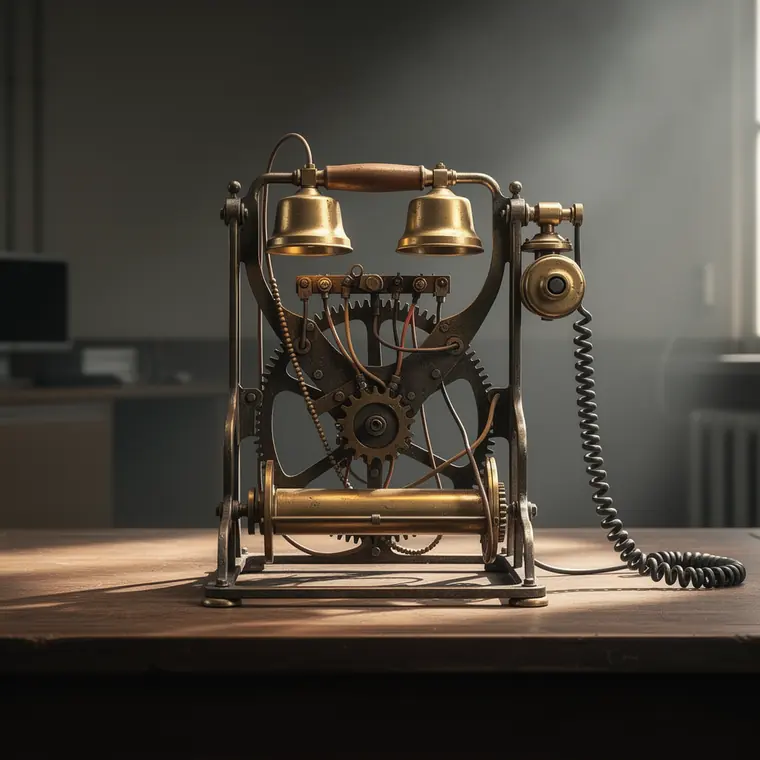
An Ericsson skeleton desk telephone in a Stockholm office, its open metal frame carrying twin bells above the handset cradle, the magneto crank at the side and a twisted cord running to the wall.
- What it was used for
- A desk instrument for local traffic through a manual exchange. The user turned the crank of the magneto generator to call the operator, lifted the handset off its hook, and cranked again at the end to ring off; the curved legs of the frame are the generator magnets. Ericsson gives 30 centimetres high, 28 wide, 14 deep and about 5 kilograms. The London Museum holds one in brass and ivory, supplied through the National Telephone Company for the Rothschilds' house at 147-148 Piccadilly, for calls to the bank in the City. Museums Victoria holds one from the head office of the Department of Mental Hygiene in Melbourne.
- What was new
- The break is not electrical but postural. Ericsson dates the skeleton frame with its doubly curved magnet steel to trials of 1884 on the model Ebh; the breakthrough, says the company history, came only in 1892 with the horizontal handset on a hook - transmitter and receiver in one piece resting on a cradle, so that one hand stays free and the instrument knows when it has been lifted. The form was not Ericsson's property: the Bell Telephone Manufacturing Company and Western Electric built their own Eiffel Tower sets, and Ericsson itself traces the construction to the Paris tower of 1889. The openly displayed mechanism then became a luxury article - the newspaper Arbetet in 2008 named ten examples in gold and ivory for the Russian court - and for a time Ericsson ran Sweden's largest joinery works, to clothe telephones in marquetry.
Connections
Every connection names its kind. “Forerunner” on its own would be a claim.
- Follows fromTour Eiffel1889Ericsson itself traces the construction to the tower: the company history states that the design of the Skeleton Type is based on the components being joined together exactly as on the contemporary and, apart from its size, similar Eiffel Tower in Paris. What was taken over is the form, an open frame of load-bearing parts, not electrics; the frame itself is the curved magnets of the generator.Source: Ericsson corporate history: The Skeleton Type (1892)
Further reading
- Ericsson corporate history: The Skeleton Type (1892)
- London Museum, Inv. 2003.2/251a: Skeleton telephone, Rothschild, 147-148 Piccadilly
- Tekniska museet / DigitaltMuseum, Inv. TEKS0001871: Telefonapparat, modell Ebh (Tax), Lars Magnus Ericsson
- Museums Victoria, Item SH 850481: Ericsson skeletal telephone, Department of Mental Hygiene, Melbourne
- Arbetet, 13. Juni 2008: Telefonen har blivit dussinvara (Taxen 1892; zehn Stück in Gold und Elfenbein für den russischen Hof; Tischlerei)
- Bob's Old Phones: Skeletal telephones (Eiffel-Tower-Apparate von Bell Telephone Manufacturing und Western Electric)