Tour Eiffel
1889 · Wrought Iron Lattice Structure · Work 70 of 1,871
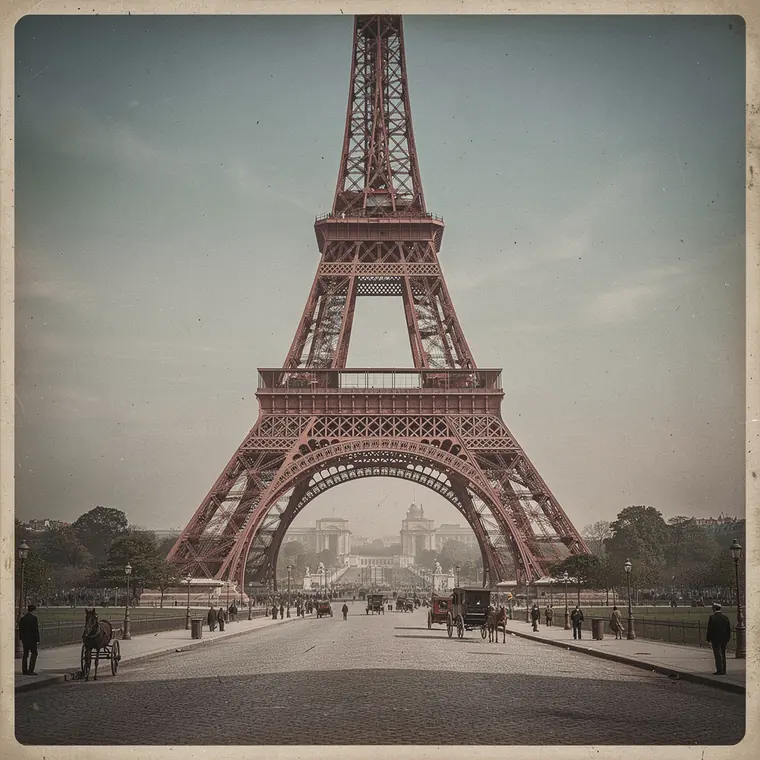
The Eiffel Tower on the Champ de Mars, a single tapering lattice pylon of four inward-curving wrought-iron legs that meet in one tall spire, the only arches being the decorative ones spanning between the legs beneath the first platform, ironwork painted reddish brown, riveted plates everywhere, hydraulic lift tracks climbing the inclined legs, pedestrians and horse-drawn carriages only around its feet.
- What it was used for
- The tower was built on borrowed time: Eiffel's concession ran for the exhibition year and twenty years after it, at which point the tower would pass to the City of Paris. In 1889, 1,968,287 paying visitors went up; the season took 6,523,847 francs, against construction costs that Eiffel puts at 7,392,305 francs for himself and 407,096 for the operating company - well over four fifths recovered in a single season. Radio saved it: in 1903 Eiffel offered the tower to the ministry of war for experiments and paid for them himself, from 1904 Captain Gustave Ferrie made it the spearhead of the military radio network, by 1908 its signals reached some 6,000 kilometres, and in 1909 a permanent station was built under the Champ de Mars. The concession was extended by 70 years.
- What was new
- Eiffel calculated the wind: by his own account the outer curve of the four edges reproduces the line of moments produced by wind pressure. And he moved precision from the site into the drawing office. Every rivet-hole spacing was calculated in advance to a tenth of a millimetre, 18,038 different parts on 5,300 drawings; Eiffel sets this expressly against English practice, at the Forth Bridge for instance, where part of the holes were drilled during erection. On site 1,050,846 rivets were driven. The idea itself was older: Clarke, Reeves & Co. had proposed a 1,000-foot tower in 1874 for the Philadelphia exhibition of 1876, and it was never built. Nobody died building the tower; the one fatality, Angelo Scagliotti, was killed on 24 May 1889, after the opening, installing a lift.
Connections
Every connection names its kind. “Forerunner” on its own would be a claim.
- Follows fromViaduc de Garabit1884When Koechlin and Nouguier drew the first sketch of the three hundred metre tower on 6 June 1884 they were finishing Garabit; the operating company's own account says the drawing came straight from the tall lattice piers of Eiffel's viaducts. The tower is their "direct heir" - same method, same team.Source: Tour Eiffel (Betreibergesellschaft): The Eiffel Tower, daughter of tall metal viaducts · Tour Eiffel: Maurice Koechlin, the engineer without whom the Tower would not exist
- Follows fromPonte Maria Pia1877On the operator's site the historian Bertrand Lemoine calls the tower the direct heir of the great iron viaducts and their tall pylons: the same lattice construction, the same assembly methods, the same forms, the same teams. The Douro arch, opened on 4 November 1877 and carried on oblong pyramidal pylons, revolutionised the art of bridges, he writes; the same page calls Garabit its twin brother.Source: Société d'Exploitation de la Tour Eiffel: The Eiffel Tower, daughter of tall metal viaducts · Comboios de Portugal: Ponte Maria Pia (Bauzeit, Eröffnung 4. November 1877)
- Works withRuhmkorff Coil1855From 26 October 1898 Eugène Ducretet transmitted from the third platform to the Panthéon, 4 km away. A Ruhmkorff coil with a 25 cm spark drove the oscillator; one of its spheres, his report to the Académie says, was connected directly to the metal mass of the tower, "which thus played the part of earth".Source: Gustave Eiffel: La tour de trois cents mètres, Paris 1900, Abschnitt „Télégraphie sans fil“ (Abdruck von Ducretets Mitteilung an die Académie des sciences, 7. November 1898) · Société d'exploitation de la tour Eiffel: La tour Eiffel n'a pas été détruite, sauvée par la radio (nur Ducretet, Panthéon, 4 km; nennt den 5. November 1898)
- EncounteredEdison Business Phonograph1888In 1889, during the World's Fair, Eiffel invited Thomas Edison to the tower; Edison's gift to his host was the latest version of his phonograph, which by then recorded on wax cylinders. A cylinder at the Smithsonian opens with "le six novembre en Haut de la Tour de Monsieur Eiffel", recorded on 6 November 1889, the fair's last day; by whom is not clear.Source: Carlene E. Stephens, National Museum of American History (Smithsonian): What did 1889 sound like? (2019) · Gustave Eiffel: La tour de trois cents mètres, Paris 1900, „Principales visites faites au sommet“ (Edison unter den Besuchern 1889)
- EncounteredGalerie des Machines1889Both stood on the Champ de Mars in Paris in 1889, at the world's fair that opened on 6 May. The tower was built for this fair and opened on 15 May; more than two million people visited it between May and November 1889. The Galerie des Machines was then the largest metal structure in Europe and housed the machines on show.Source: Bureau International des Expositions: Expo 1889 Paris
- EncounteredBollée's Multiplication Machine1889Exposition Universelle, Paris, 6 May to 31 October 1889: the tower was the fair's most recognisable symbol, open to the public from 15 May, with more than two million visits before it closed. At the same exhibition Léon Bollée's direct multiplying machine won a gold medal.Source: Bureau International des Expositions: Expo 1889 Paris · Arithmeum, Universität Bonn: A gold medal for multiplication - Léon Bollée (1870-1913) and his inventions
Further reading
- Gustave Eiffel, La tour de trois cents metres, Paris 1900 (BnF-Digitalisat, Volltext)
- Société d'exploitation de la tour Eiffel: Why was the Eiffel Tower kept?
- Tour Eiffel, Fiche 07: Allo, la tour Eiffel (Ducretet 1898, Ferrie 1904)
- Tour Eiffel: Construction, an exemplary project (keine Toten, Scagliotti 1889)
- Robert M. Vogel, Elevator Systems of the Eiffel Tower, Smithsonian, Paper 19