Ponte Maria Pia
1877 · Wrought Iron Hinged Arch · Work 44 of 1,871
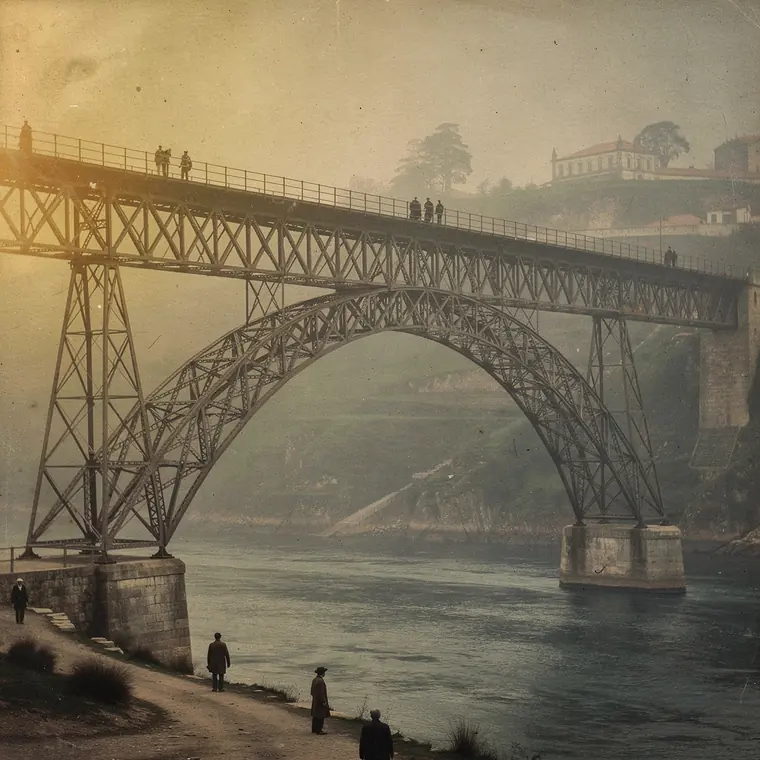
The Maria Pia Bridge over the Douro at Porto, a single crescent-shaped wrought-iron lattice arch, deepest at its crown and tapering to a point at each end where it is hinged on the granite abutments, the arch sits entirely BELOW the railway deck, the deck rests on top of the crown of the arch and on short lattice posts standing on its back, the straight lattice girder deck continued across the gorge on slender pyramidal lattice piers.
- What it was used for
- A single track railway bridge over the Douro at Porto, inaugurated on 4 November 1877 by King Luis I and Queen Maria Pia. It closed the gap in the Lisbon-Porto line, which until then had ended on the south bank. It cost 965,000 French francs, the cheapest of the four tenders and around two thirds the price of the next. Built between 5 January 1876 and 31 October 1877, about 1,500 tonnes of iron, 353 m long, with a 160 m arch 60 m above the river. It was retired in 1991: still single track, still limited to 20 km/h, and replaced by the Ponte de São João.
- What was new
- At this point the Douro is too deep and too fast for falsework in the river bed. The two halves of the arch were therefore built out from the abutments and held on cables from the piers until they met in the middle. At 160 m the arch exceeded the 158.5 m of the Eads Bridge. Authorship is disputed: the contractor was Eiffel & Cie., the design work is usually credited to Théophile Seyrig, and the calculations and drawings partly to Henry de Dion.