Edison Business Phonograph
1888 · Wax Cylinder Dictation · Work 555 of 1,871
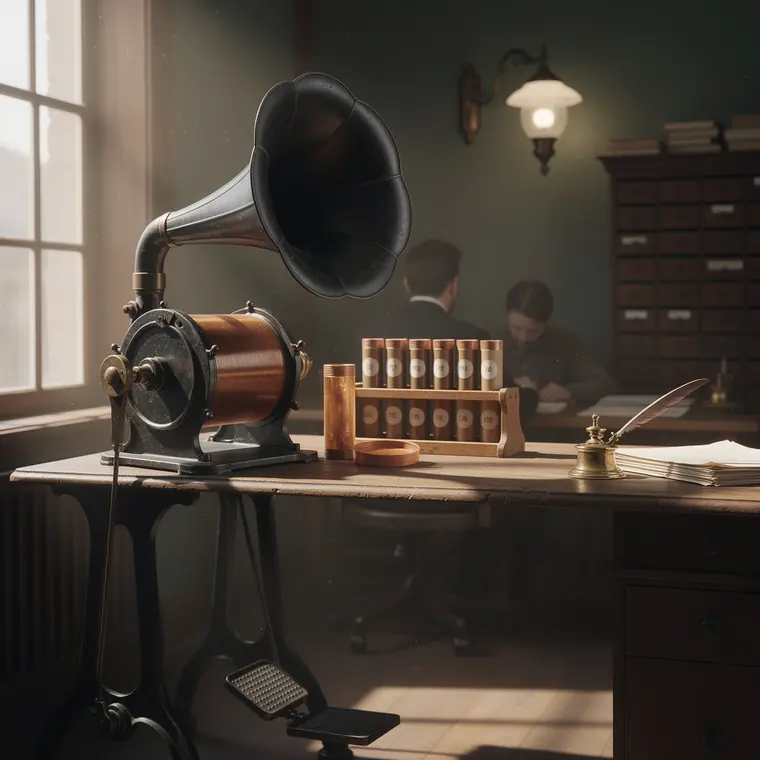
A cylinder phonograph on an iron stand with a wide speaking horn on a jointed arm, the horn of black japanned metal, the mandrel carrying a brown wax cylinder, a rack of wax cylinders in cardboard tubes with plain round labels behind it, a foot pedal on the floor below linked by a rod to the machine, the stand beside a flat desk beneath a tall window on the left, a gas bracket with a frosted globe on the wall, a brass inkwell and plain papers on the desk, a roll-top desk and a pigeonhole cabinet behind, the office reaching into shadow with dark unlit figures at the far desks.
- What it was used for
- The business phonograph was a phonograph that recorded not music but dictation: the superior spoke into a speaking tube, the cylinder went to a typist who listened to it and typed the letter. The idea was older than the machine — the Smithsonian National Museum of American History records that "In April 1878 Edison licensed rights to sell the phonograph as a machine for office dictation", but sales were poor and production soon stopped. On 14 July 1888 the North American Phonograph Company was formed, and the businessman Jesse H. Lippincott leased the machines as office dictating machines to companies with assigned territories. According to the Library of Congress, the business was not very profitable and met significant opposition from stenographers; when Lippincott lost control in the autumn of 1890, Edison switched from renting to outright sales.
- What was new
- What was new was the medium, not the idea: Alexander Graham Bell's team — Chichester Bell and Charles Sumner Tainter — replaced Edison's tinfoil with wax-coated cardboard cylinders, patented in 1886, and only then could the recorded cylinder be handed to a typist for transcription. Patent-infringement suits followed and were settled by cross-licensing in 1896. The barb: Edison brought out a machine made for the office only in 1905 and the Ediphone in 1916 — 38 years after the first dictation licence. According to figures compiled by IEEE Spectrum, 15,000 dictation machines were sold in the United States in 1923 against 744,000 typewriters.
Connections
Every connection names its kind. “Forerunner” on its own would be a claim.
- EncounteredTour Eiffel1889On 10 September 1889, during the World Exhibition, Edison called on Gustave Eiffel in his apartment at the top of the tower and gave him the latest phonograph model, the "Class M". Eiffel's voice was recorded on that machine; the 1891 recordings are held at the Bibliothèque nationale de France.Source: Tour Eiffel (offizielle Seite): Thanks to the phonograph, Gustave Eiffel's voice travels through the ages