Viaduc de Garabit
1884 · Wrought Iron Crescent Arch · Work 47 of 1,871
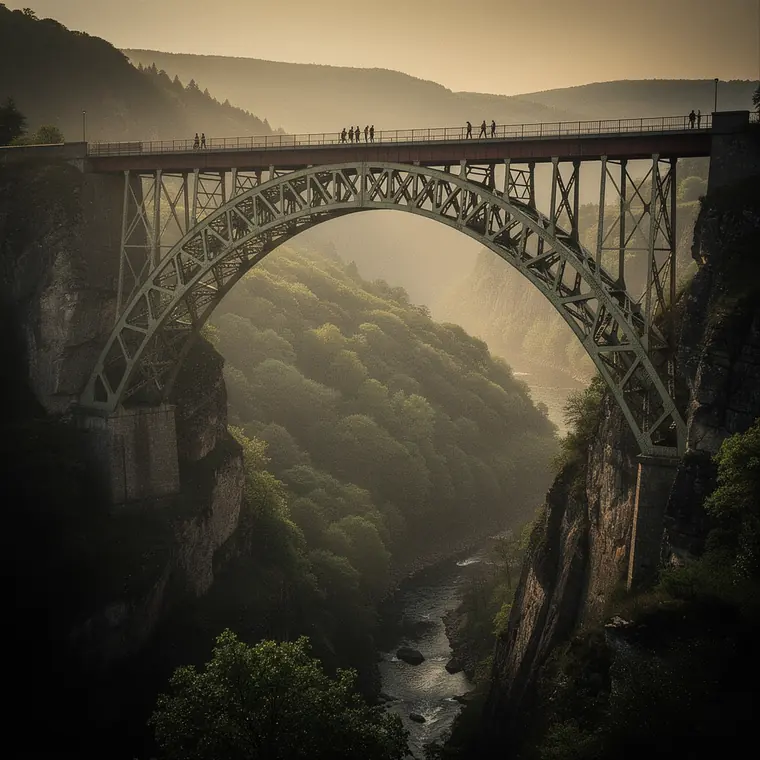
The Garabit Viaduct above the Truyere valley, its crescent lattice arch pinned at two rock bearings, tapered iron piers and riveted cross-bracing carrying the single-track deck.
- What it was used for
- A railway viaduct over the valley of the Truyère in the Cantal, for the Marvejols-Neussargues link on the Béziers-Neussargues line. The crossing was designed by Léon Boyer of the Corps des ponts et chaussées; Eiffel's firm built it, with Maurice Koechlin as structural engineer. Arch span 165 m, deck originally 122 to 124 m above the river, 564.7 m long, about 3,250 tonnes of metal, 3.1 million francs, built 1881 to 1884 with the arch closed on 17 September 1884. Sources disagree on when the first train ran: November 1885 per Structurae and Wikipedia, 1888 per the SNCF archives; the point is disputed.
- What was new
- Garabit was not a new principle but the enlargement of a proven one: the method of the Ponte Maria Pia, seven years earlier, taken to a greater span and three times the height. What was new was the accuracy of the calculation: the measured deflection under load was 8 millimetres, exactly the figure predicted. The height that made its reputation is gone, though - after the Truyère was dammed the deck stands only about 90 m above the water.
Connections
Every connection names its kind. “Forerunner” on its own would be a claim.
- Follows fromPonte Maria Pia1877Structurae: the technical problems matched those at the Douro, and it was Eiffel & Cie's success there that led to the proposal for Garabit in the first place. The same method: a wrought iron crescent arch hinged at the abutments, cantilevered out from both banks on cables, no falsework in the river. 160 m in 1877, 165 m in 1884.Source: Structurae: Garabit Viaduct (Loubaresse/Ruynes-en-Margeride, 1884) · ASCE Historic Civil Engineering Landmarks: Ponte Maria Pia Bridge · Université Gustave Eiffel, Reflexscience: Gustave Eiffel and his construction of metal arch bridges