Ruhmkorff Coil
1855 · Induction Coil · Work 224 of 1,871
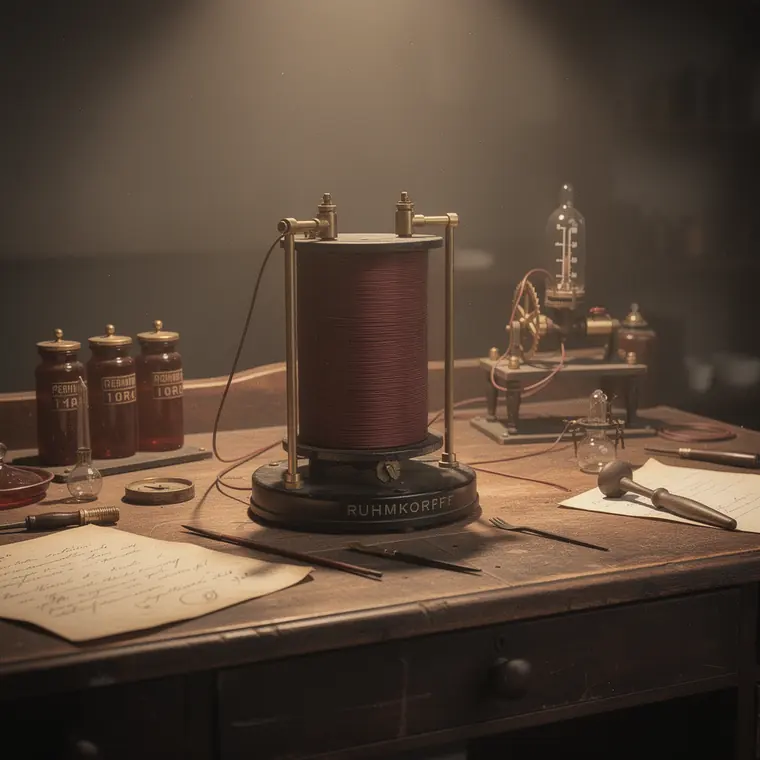
A Ruhmkorff induction coil on the bench of its maker's Paris workshop, ebonite cylinder wound with fine wire between brass discharge posts, mercury interrupter and battery jars beside it.
- What it was used for
- Heinrich Daniel Ruhmkorff, an instrument maker from Hanover, built induction coils for laboratories in his Paris workshop, which at times employed up to 25 workers. Such a coil turned the low-voltage current of a battery into high voltage. It was used to make long sparks, set off explosive charges and run Geissler and Crookes tubes; early radiologists powered their X-ray tubes with it. According to Nature, the coil appeared in 1851 and received a medal at the 1855 Exhibition. I found no documented spark lengths for Ruhmkorff’s own coils in any source I could reach.
- What was new
- Ruhmkorff did not invent the principle. Nicholas Callan at Maynooth described in 1836 a coil of thick and thin wire on an iron core with an interrupter; Charles Page and J. H. Abbot built large coils in the United States in 1838–40. Ruhmkorff's design combined several improvements: a very long secondary winding insulated layer by layer, an automatic hammer interrupter and, from about the mid-1850s, Fizeau's condenser of 1853. Still, the name stuck to him. The 1911 Encyclopaedia Britannica considered the label unnecessary; the Maynooth museum attributes it to makers putting their own names on the coils.