Bollée's Multiplication Machine
1889 · Multiplication Plate · Work 429 of 1,871
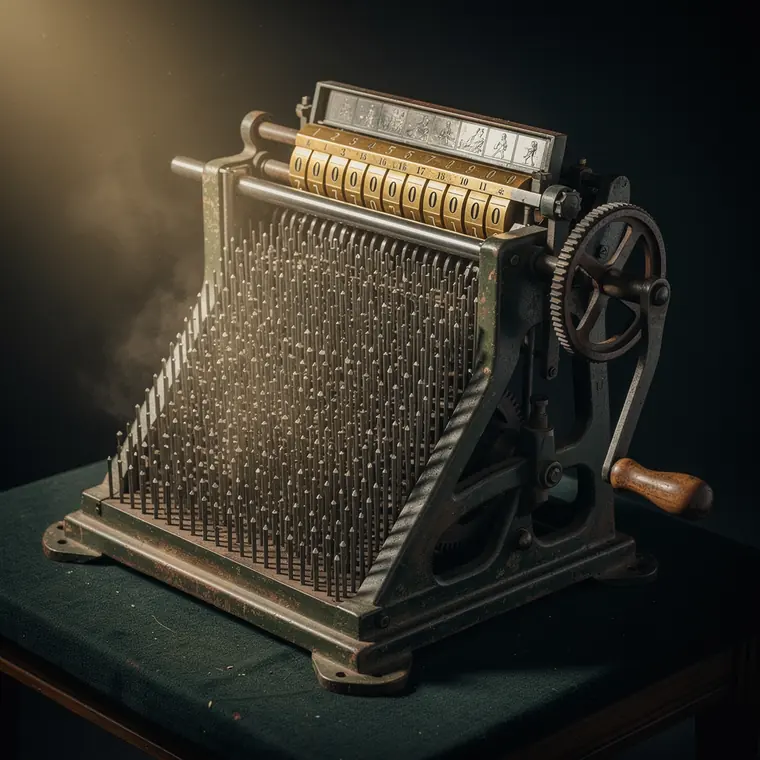
A large calculating machine with a bed of small vertical steel pins of graded heights forming a physical multiplication table, the pin bed the dominant form, a heavy carriage riding above the pin bed on rails, a wheel-and-crank drive on the side with a turned wooden handle, a row of numeral windows on the carriage, each window showing the single digit 0, every other surface plain iron and brass, standing on a dark baize-covered table before a deep neutral background, a single raking light from the left raking across the pins so their graded heights read as a stepped landscape.
- What it was used for
- No working use is documented; according to the Arithmeum, Bollée built only a few examples. The Smithsonian gives its example, dated about 1892, as 45.5 x 104 x 38 centimetres; the Arithmeum puts the original at over 80 kilograms and over a metre wide. That is not an office device but a piece of furniture. The Musée de Tessé in Le Mans holds one, which the Arithmeum in Bonn dismantled and restored for an exhibition.
- What was new
- The multiplication body stores the whole times table mechanically: set multiplicand and multiplier, and rods pick off the product and transfer it — one operation per digit of the multiplier instead of several crank turns. Verea had already done direct multiplication in 1878 with holes of varying depth in prisms; Bollée did it with pins of different sizes. The dates belong to different kinds: 1889 is the year of the gold medal at the Paris Exposition Universelle, the not quite eighteen-year-old had the machine finished between February and April 1888 according to bibnum, and US patent 556720 was granted only on 17 March 1896. Others sold the principle: a few years later Otto Steiger patented a direct multiplier that sold widely as the Millionaire. The HNF writes that the maker, Hans W. Egli, took the multiplication body over from Bollée.
Connections
Every connection names its kind. “Forerunner” on its own would be a claim.
- EncounteredTour Eiffel1889Paris world's fair of 1889: Léon Bollée exhibited his multiplication machine there and received a gold medal, recorded on the machine's brass plate. The Eiffel Tower was, as the Library of Congress states, the central attraction of that same exposition.Source: Smithsonian NMAH, Bollée Calculating Machine · Library of Congress, Prints & Photographs: Paris Exposition of 1889