Berlin Call Office
1881 · Public Call Office · Work 144 of 1,871
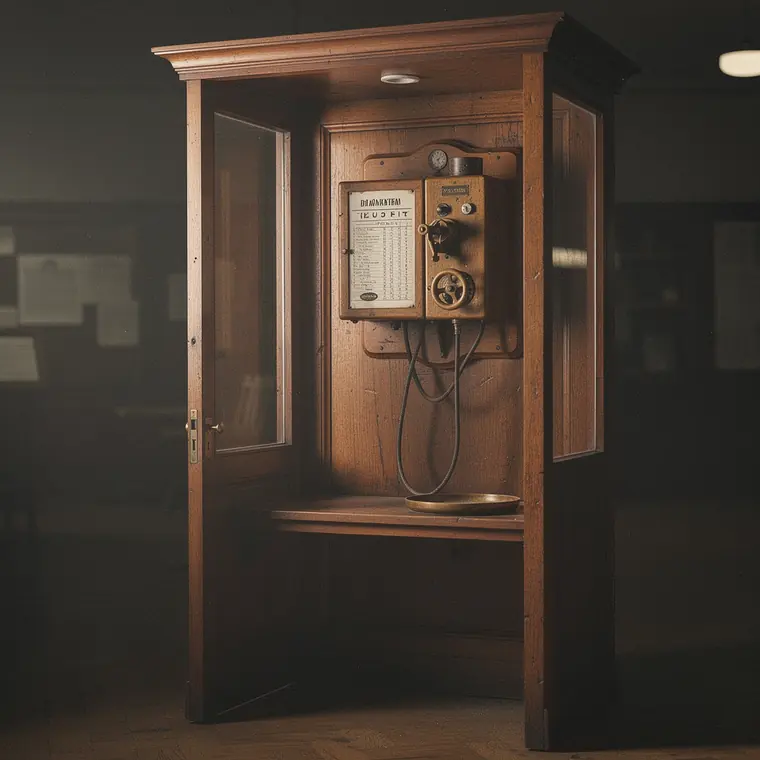
A public telephone cabinet in a Berlin post office, a panelled wooden booth with a glazed door enclosing a wall set with crank magneto, the set a plain wooden wall box with a hand crank on its side, a coin dish and a printed list of subscribers, the post office counter with brass rails and a gas or oil lamp, the clerk in a uniform coat and the caller in a frock coat and top hat.
- What it was used for
- The Reichspost opened Berlin's city telephone network in April 1881; the switchroom was at Französische Straße 33c, and by December 1881 two further exchanges had been added in Mauerstraße and Oranienburger Straße. According to Unger the directory listed ministries, public offices, railway administrations, banks and trading houses, factories, newspaper offices, lawyers and doctors; the stock exchange had number 1. A connection cost about 200 marks a year - according to the Museum für Kommunikation Berlin, as much as five nights in the luxurious Central-Hotel. Anyone not paying that depended on the public call offices, and these were thin on the ground: at the end of 1881 C. L. Unger counted two in the whole of Berlin, at Unter den Linden 5 and the Potsdamer Tor, at 50 pfennigs per five minutes of speaking time.
- What was new
- Telephones had existed in Germany since 1877, but as fixed point-to-point links. The exchange made every subscriber reachable without laying a new wire: between 1 and 21 December 1881 Berlin's exchanges made 34,539 connections, with 668 registered stations. This was no world first, and even for Germany the order is disputed - in his lecture of December 1881 Unger names Mülhausen in Alsace before Berlin, and by the end of 1881 seven cities were working. The number of subscribers at opening is unclear: Unger, the contemporary source, writes 87; Berlin chronicles give 8 for the trial service from 12 January and 48 for 1 April 1881. The barb is in Unger's own sentence: only after repeated public appeals was a sufficient number of subscribers won. The state had built an instrument whose value to its first customer was zero; Berlin's first subscriber list was known as the book of fools.
Further reading
- C. L. Unger, Die Fernsprechanlagen im Gebiete der Deutschen Reichstelegraphenverwaltung, Polytechnisches Journal Bd. 243 (1882), S. 341
- Zentralblatt der Bauverwaltung, 7.1.1882: Bericht über Ungers Vortrag vom 27.12.1881
- Deutsche Digitale Bibliothek / Museum für Kommunikation Berlin: Die Berliner Telefonbücher von 1881 bis 1902
- Gerhild Komander: Das erste Berliner Telefonbuch 1881 (acht Teilnehmer beim Probebetrieb ab 12. Januar 1881; Buch der Narren)
- Chronologie des Berliner Fernsprechwesens (Schwender): 48 Teilnehmer am 1. April 1881