Telefontornet
1887 · Telephone Tower · Work 145 of 1,871
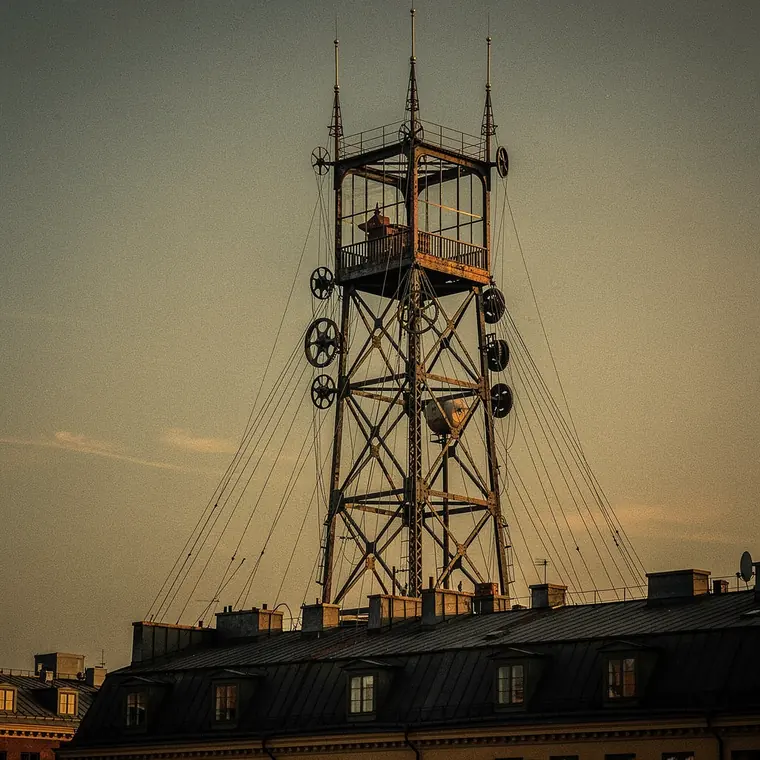
The Stockholm telephone tower rising from a city rooftop, an iron lattice cage with four corner spires carrying thousands of bare wires that fan out over the surrounding streets to the house gables.
- What it was used for
- The tower was not a transmitter but a cable distribution frame on a roof. On the new exchange of Stockholms Allmänna Telefonaktiebolag in Malmskillnadsgatan stood an iron frame from which, according to Ericsson and the Swedish Järnvägsmuseet, 4,000 telephone wires ran out over the roofs of the inner city. It was used not by subscribers but by the company: it carried the wires, and Ericsson calls them especially sensitive to the elements. The plant belonged to Henrik Tore Cedergren's company, whose stated aim was a telephone in every household. Ericsson counts 4,832 subscribers for the period and around 5,000 kilometres of line in Stockholm.
- What was new
- What was new was density, not range. The tower solved a problem only a successful telephone company has: how to bring thousands of separate open wires together in one building while multi-pair underground cable is not yet practical. It was not an invention; the Järnvägsmuseet claims for the station that it was the largest of its kind, and for Stockholm the highest telephone density in the world at the time. The barb is the duration. On Ericsson's account the networks were underground by 1913 - so the tower was functionless within a working lifetime - and then stood for another forty years, latterly as a mount for a clock. It burned on 23 July 1952 and was demolished in 1953; the Stockholm city museum says only that it was demolished after a fire in 1952. Later accounts say the fire broke out in the Televerket radio laboratory beneath the tower.
Further reading
- Ericsson: When the telephone lines darkened the sky in Stockholm
- Järnvägsmuseet (Sveriges Järnvägsmuseum) via Europeana: Telefontornet, Malmskillnadsgatan
- Stockholmskällan / Stockholms stadsmuseum: Telefontornet
- DIS (Föreningen för datorhjälp i släktforskningen): Telefontornet 1890 (Radiolaboratorium des Televerket, Brand 23. Juli 1952, Abriss 1953, NK-Uhr 1939)