Branly Coherer
1890 · Coherer · Work 147 of 1,871
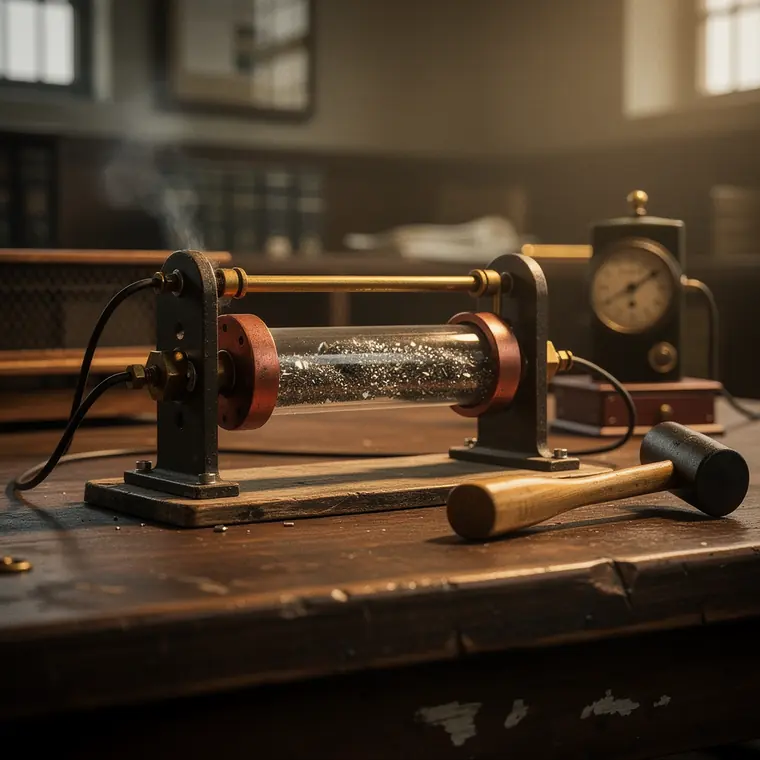
Branly's filings tube on a Paris laboratory bench, a small glass tube of loose metal filings clamped between two plugs and wired to a cell and galvanometer, a tapping hammer standing alongside.
- What it was used for
- Édouard Branly made the observation on 24 November 1890 in his laboratory at the Institut Catholique de Paris, 21 rue d'Assas - so the IEEE plaque dates it; on 24 November 1890 his note went to the Académie des sciences; the references are Comptes Rendus vol. 111, p. 785 (1890) and vol. 112, p. 90 (1891). He put metal filings between two electrodes in a small tube and measured what a distant spark did to the resistance: by Lodge's figure for Branly's copper coat it fell from some millions to some hundreds of ohms and came back on tapping or shaking. He found the same with a coat of copper powder and with pastes of filings in Canada balsam and in sulphur. Out of this tube came the detector in practically every early wireless receiver.
- What was new
- The achievement is not detecting waves but that a distant spark alters a measurable direct-current quantity: with that you can throw a relay and write a mark. Priority is spread over three names. Temistocle Calzecchi-Onesti published on the conductivity of metal filings as early as 1884 and 1885 in Il Nuovo Cimento. The name came from Lodge, in his Royal Institution discourse of 1 June 1894: because the thing appears to act by cohesion, he said, he called the arrangement a coherer. Lodge also reports that he had independently observed something similar in 1889 and had overlooked Branly's papers at the time - and he notes it is not clear that Branly recognised he was dealing with Hertzian waves. The barb is the Académie election of 23 January 1911: Branly won the seat against Marie Curie by two votes, backed, on the American Institute of Physics' account, by French Catholics and patriots who felt stung by his exclusion from the 1909 Nobel Prize that went to Marconi.
Further reading
- IEEE Milestone (ETHW): Discovery of Radioconduction by Edouard Branly, 1890
- Oliver J. Lodge, Signalling Across Space Without Wires, 3. Aufl., S. 20, S. 34, S. 82-83 und Fußnote 12
- T. Calzecchi-Onesti, Sulla conduttività elettrica delle limature metalliche, Il Nuovo Cimento 16(1), 1884, S. 58-64
- American Institute of Physics, History Exhibit: Marie Curie - Scandal and Recovery
- Treccani, Dizionario Biografico: Temistocle Calzecchi Onesti (Aufsätze im Nuovo Cimento 1884 und 1885)