Quicksilver Mail Coach
1835 · Mail Coach · Work 150 of 1,871
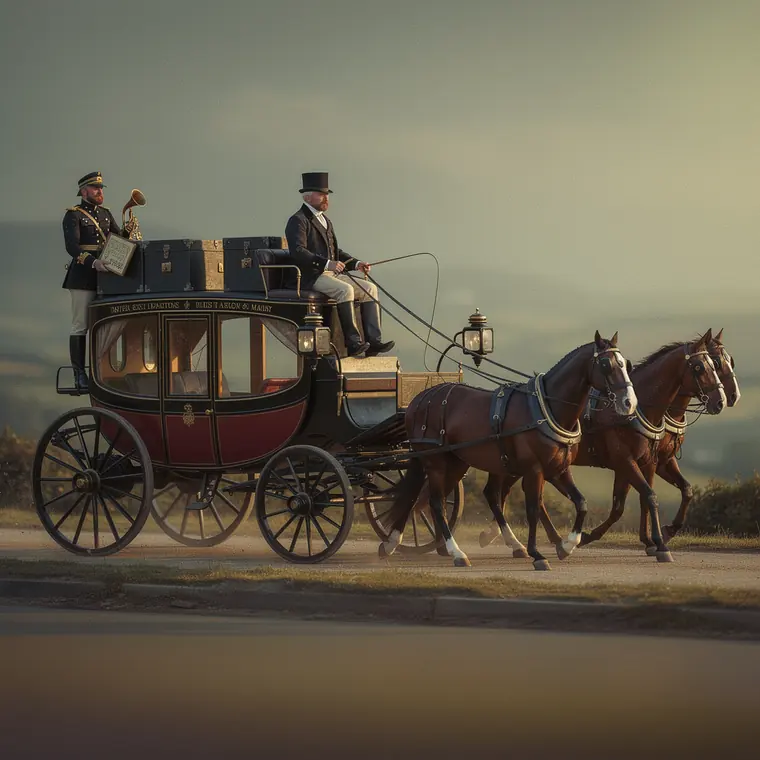
A Royal Mail coach on the Devonport road, a four-horse coach at a trot: a closed passenger body in black and maroon on a sprung undercarriage with four spoked wheels, the coachman seated high on the front box holding the reins of four horses harnessed in two pairs ahead, its rear boot loaded with locked mail boxes while the guard stands behind with a post horn and a sealed timepiece case, the horses pulling the whole vehicle along a turnpike road.
- What it was used for
- The night mail from London to Devonport. The only Post Office servant aboard was the guard, with a blunderbuss and two pistols; coachman, horses and coach belonged to the mail contractors. The guard carried the Post Office timepiece and the time-bill, on which every stage was reckoned separately, and had power to order out post-horses at the contractors' expense whenever time was being lost. Departure was 8.30 p.m. from the Gloucester Coffee-House in Piccadilly, the bags brought by cart from St Martin's-le-Grand. The 1837 time-bill gives 216 miles, 21 hours 14 minutes, arrival at Devonport at 5.14 p.m., 25 minutes for breakfast at Ilminster and ten minutes at Exeter; for Hindon and Water Gore the bags were dropped at speed.
- What was new
- What was new was not speed but contractually enforced, auditable punctuality over 216 miles at night: a Post Office clock, a stage-by-stage reckoning, and a Crown officer riding as inspector over another employer's men. The average of 10 miles 1 3/4 furlongs an hour including stops was not the highest in Charles Harper's 1837 list - the Bristol mail ran 10 miles 3 furlongs; the claim is fastest long-distance mail. On the date: 1835 is not documented for this coach. Harper quotes T. A. Trollope that the mail was started about 1820, and dates the acceleration to 1837, when it was put on the upper road by Amesbury and Ilminster. The barb follows at once. The London and Southampton Railway reached Woking in May 1838 and Winchfield in September; in October 1838 The Times carried an auction notice from Bagshot: 49 horses and six sets of four-horse harness, including one stage of the Devonport Mail, for sale because the coaches were going by railway.
Further reading
- Charles G. Harper, Stage-coach and Mail in Days of Yore, Bd. II (1903), S. 23, 31-36 (Time-Bill von 1837; Times-Anzeige Oktober 1838)
- Charles G. Harper, The Exeter Road (1899), S. 3, 11, 25 (23 Pferdewechsel; Nimrod 1836)
- The Postal Museum, London: Mail coaches
- J. M. Hawker, Changes in Travelling on the Road between Exeter and Plymouth, Transactions of the Devonshire Association, 1885