Penny Black
1840 · Postage Stamp · Work 152 of 1,871
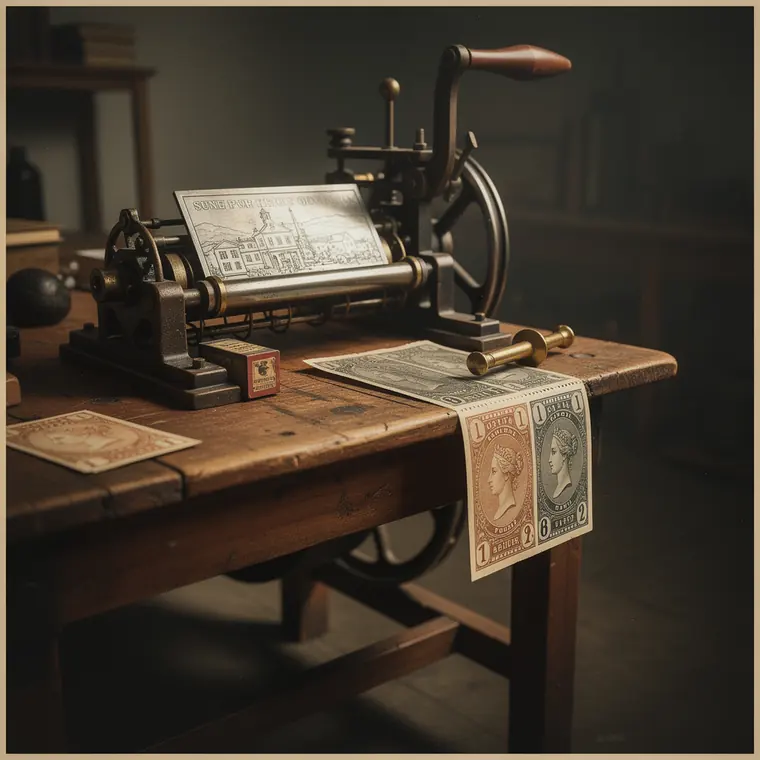
A sheet of the first adhesive postage stamps at Perkins Bacon in London, imperforate rows bearing a sovereign profile with corner check letters, beside the engraved steel plate and a hand press.
- What it was used for
- Uniform penny postage began on 10 January 1840 - the stamp is the receipt for a reform already four months old. What changed in daily practice was above all who paid: no longer the recipient on delivery, but the sender in advance. The stamp was put on sale in London on 1 May 1840 and became valid for postage on 6 May. It was printed in sheets of 240, because 240 pennies make a pound, and by May 1840 some 600,000 labels a day were being produced, according to The Postal Museum. Adhesive stamps were not compulsory for inland mail until 1859: for nineteen years the stamp stood alongside prepaid stationery and cash at the counter. The Post Office's reported net profit fell from £1,659,509 (1839) to £500,789 (1841) and did not regain its pre-1840 level until 1874.
- What was new
- Named precisely, what was new was: prepayment by the sender, a uniform rate by weight irrespective of distance, and an adhesive label as the token. Only the last is a world first. Prepayment and a penny rate already existed in 1680 in William Dockwra's London Penny Post with its PENNY POST PAID handstamp - until an action brought in 1682 in the name of the Duke of York succeeded against him. The Chalmers-versus-Hill dispute stays open: the Dictionary of National Biography calls James Chalmers the first inventor and records in the same entry that Chalmers finally admitted that his claim to priority of publication was not tenable. The barb: the black was too good. The red Maltese Cross cancellation could be removed without damaging the label, says The Postal Museum, so within a year the printing ink was changed to red-brown and the cancellation to black. The world's first stamp was withdrawn for a colour correction.
Further reading
- The Postal Museum: The first ever stamp - the Penny Black
- The Postal Museum, Datenblatt: Reported net profits 1838-1914 (Quellen u.a. First Report of the PMG, 1855, App. F, POST 92/1)
- The Postal Museum: Post Office Statistics (Rückkehr zum Gewinnniveau von vor 1840 im Jahr 1874)
- Dictionary of National Biography 1885-1900: Chalmers, James
- Dockwra's Penny Post (docwras.org.uk, nach Brumell, The Local Posts of London): Beginn 1680, vorausbezahlt, Klage im Namen des Herzogs von York 1682
- The Postal Museum: Uniform Penny Postage (Markenpflicht im Inlandsverkehr ab 1859)