Sorting Hall
1895 · Sorting Plant · Work 154 of 1,871
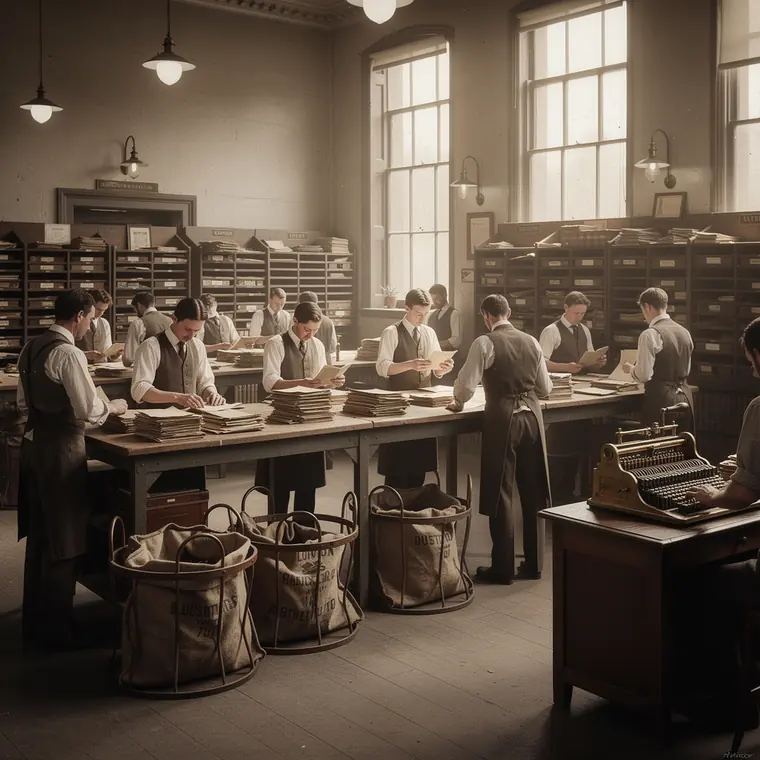
The sorting floor of a London district post office, ranks of pigeonhole frames along the tables where sorters throw letters, a dozen sorters in shirtsleeves, waistcoats and aprons standing at the frames with bundles of letters in hand, canvas bags held open on iron hoops and a hand stamping desk at the end, the hall lit by daylight through tall windows and by gas lamps hanging on brackets, the hall busy with people.
- What it was used for
- What is meant is the great sorting hall of the General Post Office at St Martin's-le-Grand, on Archibald Granger Bowie's 1897 description on the ground floor and occupying nearly the whole area of the building. In 1895 Mount Pleasant was still a parcel and stores office; the letter wing came only in 1900. Before six in the evening people crowded up to the flap with baskets and sacks full of letters, and the flap dropped at the last stroke of the hour. Then the work ran in fixed stages: facing, stamping, sorting in three stages - first by railway groups and large towns, then by lines of railway, then by roads - tying up, bagging, and mail-carts to the terminus stations. At the primary tables one pigeonhole was labelled Blind, for letters whose addresses the ordinary sorter could not decipher. Carrier-boys took the bundles from the stampers to the sorters.
- What was new
- Nothing was invented here, and this field says exactly that: the sorting hall is not a device but a form of work. What was new was organisation alone - a sortation cut not by geography but by the railway timetable, and a traceability built into the object: every stamper, Bowie records, had to sign a book beneath an impression of his own stamp, so that the postmark on the envelope was also the signature of the man through whose hands the letter passed. The barb is what is missing. In Bowie's account of the sorting hall no machine appears; the count was made by the stamper striking a separate slip after every fiftieth letter, and that is where the figure of about half a million letters a night comes from - one contemporary source, not an official statistic. The growth from 76 million letters in 1839 to 1,834 million a year (Bowie 1897) was absorbed, as far as Bowie shows, by adding people; machine reading came to Mount Pleasant only in 1979.
Further reading
- Archibald Granger Bowie, The Romance of the British Post Office, London 1897, Kap. V, S. 67-79, sowie S. 136-137
- Hansard, House of Commons, 11.3.1895: Wages of Post Office Servants (Generalpostmeister Arnold Morley: 9.646 planmäßige Kräfte, davon 4.937 mit 24 Shilling oder weniger, acht Stunden täglich)
- The Postal Museum: A History of Mount Pleasant (1890 Paketamt, 1900 Brieftrakt, 1979 OCR-Sortierung)
- James Wilson Hyde, The Royal Mail: Its Curiosities and Romance, 3. Aufl. 1889 (Gutenberg), Kap. XI (Sortierleistung 25 bis 40 Briefe je Minute; Nachtdienst)