Reuter Pigeon Line
1850 · Carrier Pigeon Post · Work 156 of 1,871
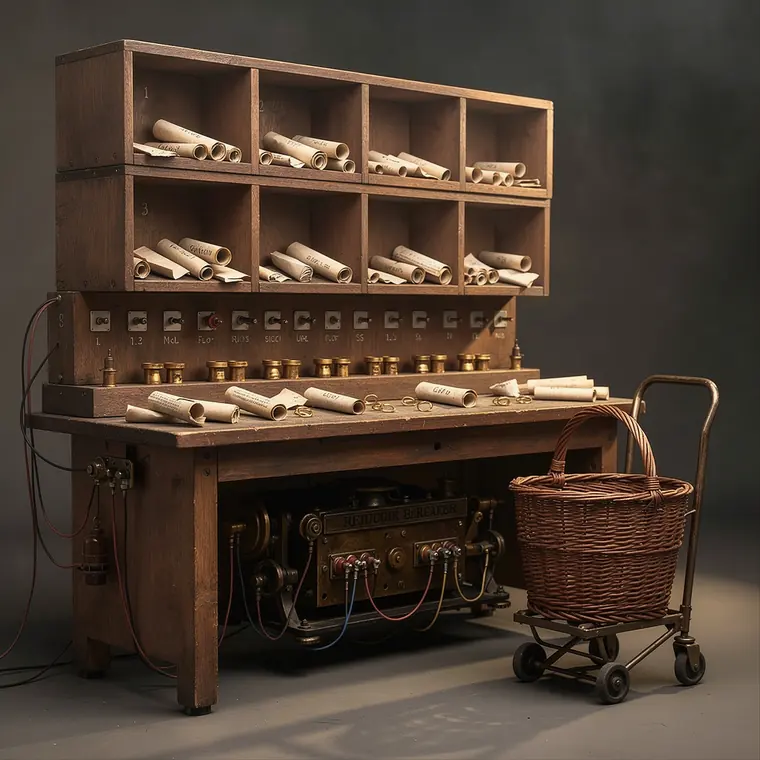
The Aachen pigeon relay station of the Reuter news service, tiers of wooden nesting boxes along the wall, tiny rolled paper messages and brass leg rings laid out on the table, a wicker travelling basket standing ready on a handcart.
- What it was used for
- Paul Julius Reuter ran an office in Aachen for forwarding telegraphic dispatches. Between Aachen and Brussels there was still a gap in the Paris–Berlin telegraph network: telegrams had to travel that stretch by rail, which took six hours. Reuter bought the shortcut. His contract of 24 April 1850 obliged the Aachen pigeon breeder Heinrich Geller to supply him with "vierzig wohl dressirte Tauben" — forty well-trained birds; the pigeons flew the stretch in two hours. Geller had to take each dispatch off the bird at once and drop it into a locked box to which only Reuter held the key. Every day the pigeons travelled back to Brussels on the very railway they had just beaten.
- What was new
- What was new was not the carrier pigeon but the chain: telegraph, pigeon, telegraph run as one line with a contract, a deadline and control of the key. Reuter was not selling speed but the bridging of a gap between two states' networks — a business that lasted exactly as long as the gap did. It closed within months: the Aachen–Verviers telegraph line opened on 2 October 1850, and by March 1851 the Belgian network was connected to the Prussian one. Reuter left and opened an office in October 1851 close to the London telegraph offices. On the number itself: the Museumsstiftung Post und Telekommunikation, which holds the contract, reads "forty"; the widely repeated 45 birds are not in that document.
Further reading
- Museumsstiftung Post und Telekommunikation: Brieftaube (mit Vertrag Reuter/Geller, 24.04.1850)
- Thomson Reuters: Company history
- The Baron (Archiv ehemaliger Reuters-Journalisten): Enter Heinrich Geller
- Deutsche Biographie: Reuter, Julius Baron de (Brieftaubendienst 1850/51 über die 140 km lange Lücke Aachen–Brüssel zwischen Berlin–Aachen und Brüssel–Paris; London Juni 1851)