Blower Linotype
1886 · Line Casting Machine · Work 158 of 1,871
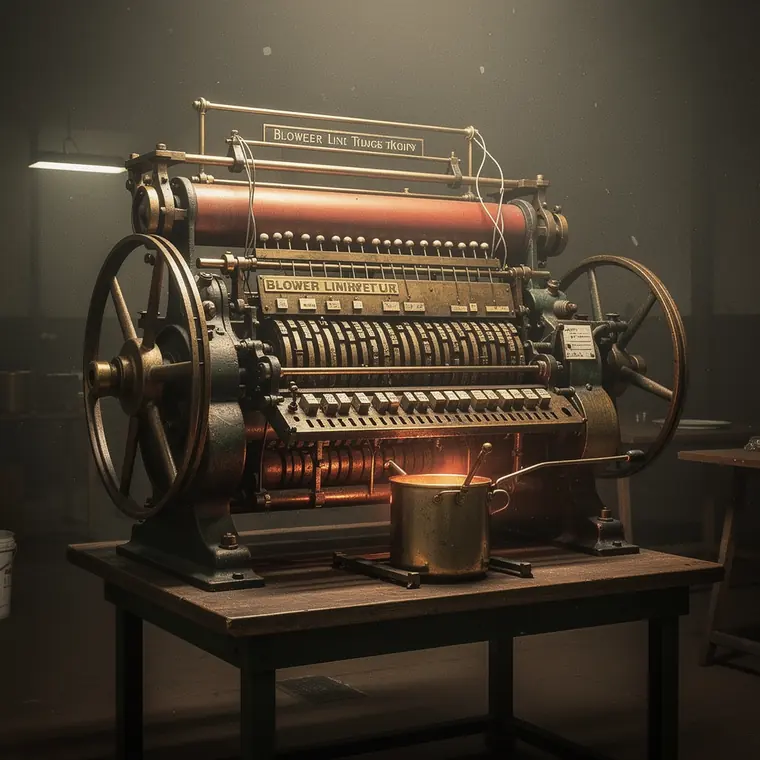
A Blower Linotype in the New York Tribune composing room, matrices sliding from the magazine into the assembling elevator beside the metal pot and casting wheel that delivers a solid line of type.
- What it was used for
- The first machine stood on the ninth floor of the New York Tribune building, whose publisher Whitelaw Reid headed the newspaper syndicate that had financed Ottmar Mergenthaler's development. On 3 July 1886 it set the editorial page and straight matter there; nothing was announced. By the end of that year a dozen machines were running, thirty by 1887; one set roughly 5,000 to 7,000 characters an hour according to the German Historical Institute in Washington. The nickname came from the blast of air that carried the matrices to the assembler. Mergenthaler was not allowed to improve the unreliable machine; he resigned in March 1888, set up his own workshop in Baltimore and from 1890 built the improved machine there under contract for the very company that bore his name.
- What was new
- What set it apart from every competing composing machine was distribution. Paige, Thorne and Burr set existing single types, which after printing had to be distributed again letter by letter; Mergenthaler circulated matrices instead, cast a lead slug from them and melted the lead down again — the second operation simply disappeared. James W. Paige's rival machine had, according to the Linda Hall Library, some 18,000 parts and imitated the compositor's own movements; Mark Twain, the same source says, put some 300,000 dollars into it and lost it all. The Blower itself lasted four years: in 1890 inclined magazines replaced the blast of air that had given it its name, while the casting principle stayed until American Linotype production ended in 1971.
Further reading
- Immigrant Entrepreneurship (German Historical Institute): Ottmar Mergenthaler
- Amalgamated Printers' Association: July 3, 1886 — The Linotype
- Linda Hall Library, Scientist of the Day: Mark Twain (Paige-Setzmaschine)
- CircuitousRoot: Mergenthaler Linotype Models (Blower: 212 gebaut, Produktionsende 1890)
- American Printing History Association: Linotype Invented and Built in Baltimore (Verbot von Verbesserungen an der Blower; Kündigung März 1888; ab 1890 Bau des Model 1 in Baltimore im Auftrag der Firma)
- CircuitousRoot: Thorne / Simplex / Unitype (Setzmaschine für vorhandene Typen mit automatischem Ablegen; Linotype goss Zeilen und schmolz sie wieder ein)
- EBSCO Research Starters: Ottmar Mergenthaler (rund 200 Blower bis 1890; US-Fertigung der Linotype endete 1971)