Monotype Keyboard
1897 · Single Type Composing Machine · Work 159 of 1,871
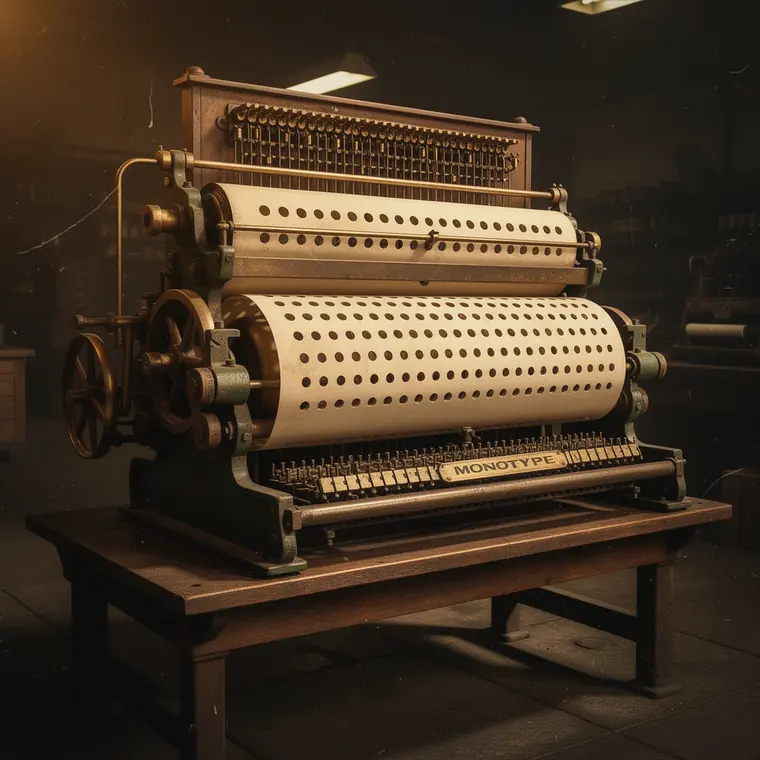
A Monotype keyboard punching a wide paper ribbon with pairs of holes, the spool feeding the separate caster whose matrix case shifts above the mould in a London printing house composing room.
- What it was used for
- The object is the keyboard half of a two-part system: it printed nothing and cast nothing, but punched a paper ribbon that controlled the casting at a physically separate machine. Thirty-one punches stood across the travel of the ribbon; twenty-eight selected the matrix, two set the justifying wedges and one the space-transfer wedge. The system was used for book work and for formula setting. The ribbon ran into the caster backwards: "Last perforations made by Keyboard are first perforations presented to Casting Machine", says the maker's own manual of 1912 — the caster needs the line's justification before it casts the first letter, while the operator keys it last.
- What was new
- What was new was the separation of keying from casting: where on the Linotype one man sat at the machine that cast the metal, here several keyboards could feed one caster, and the keyboard operator handled no metal at all — which the maker's manual presents as a kindness and which at the same time split the compositor's trade into two halves. Because the system cast single types rather than slugs, an error could be pulled out of the matter by hand instead of recasting the line. The patent dates differ because they mean different things: Britannica says 1885, the Science Museum 1887; patent US 364,522 goes back to an application of 30 September 1885, was filed as a divisional on 3 July 1886 and granted on 7 June 1887. The price is in Britannica: slower and more expensive to operate than Linotype, hence rarely used for solid text.
Further reading
- Lanston Monotype Machine Company: The Monotype System, Philadelphia 1912 (Volltext)
- Science Museum Group Collection: Composition keyboard, Lanston Monotype, 1897
- Patentschrift US 364522 A, Tolbert Lanston: Producing Justified Lines of Type
- Encyclopaedia Britannica: Monotype typesetting machine
- Science Museum Group Collection: The Lanston Monotype Corporation Ltd (Tastatur und Gießmaschine 1887 in den USA patentiert)
- Amalgamated Printers' Association: The Monotype Story (eine Gießmaschine für zwei bis drei Tastaturen; Tabellen- und Buchsatz)