Walter Press
1866 · Rotary Printing Press · Work 160 of 1,871
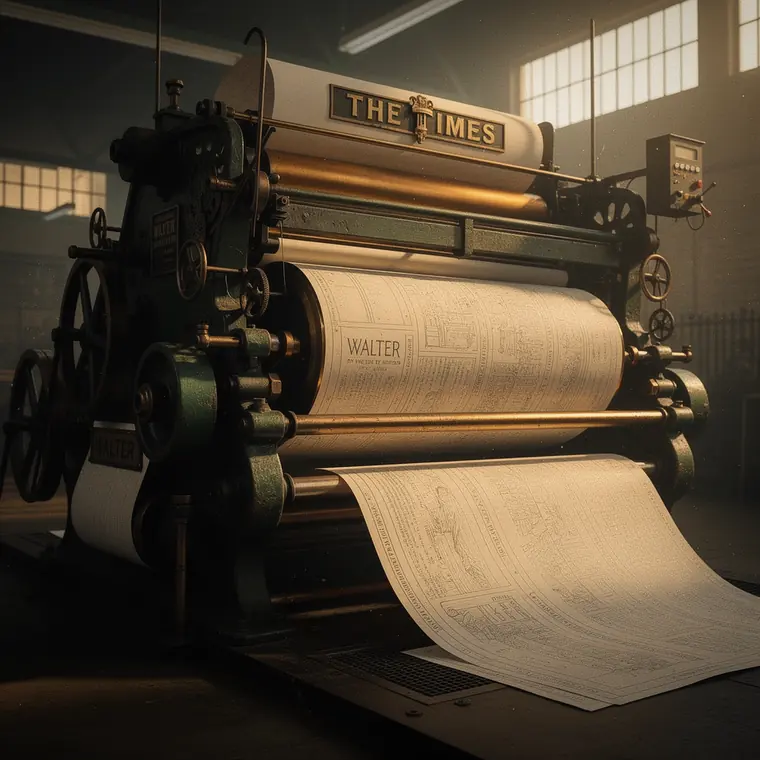
The Walter press in the printing house of The Times, curved stereotype plates clamped to the rotating cylinders while a continuous paper reel unwinds through the nip and cut sheets fall into the delivery.
- What it was used for
- The Times built its rotary machine in its own printing house instead of buying it from an engineering firm. The web ran off the reel, was damped, printed on its front side above and its back side below, then cut and delivered. Each reel was, according to John Southward's handbook, about 8,000 yards long — more than four miles — and weighed 800 pounds. Output is given as 12,000 copies an hour, printed on both sides. At the Times the type stayed in service until 1895; according to Robert Hoe three newspapers used it: the Times, the London Daily News and the New York Times.
- What was new
- Web printing was not new. William Bullock's American patent no. 38,200, granted on 14 April 1863, claims in claim 1 the feeding of paper "from a continuous roll or web" and in claim 5 combines feed roller and cutting cylinder. What was new was reliability: Bullock's machine, Robert Hoe writes, was set up in several offices and rejected again "because of its unreliability" before, as Hoe adds, it was finally perfected enough to come into considerable use; the Walter press stacked cylinders of equal size one above the other and on that basis ran a world newspaper's print run night after night. The year is blurred too: Hoe writes "about 1868", the Science Museum dates its model to 1868, Southward puts its completion in 1869, Japan's National Diet Library to 1866. The price was the paper — by Hoe's account the press required a very strong and expensive paper that the cheap daily press could not afford.
Further reading
- Robert Hoe: A Short History of the Printing Press (1902), Volltext
- Patentschrift US 38200 A, William Bullock: Printing-Machine (14.04.1863)
- John Southward: The Principles and Progress of Printing Machinery (Volltext)
- National Diet Library (Japan): Printing-related Machinery, Walter Rotary Press
- Science Museum Group Collection: Walter Rotary Printing Press at 'The Times', 1868 (Modell, Inv. 1977-549)
- History of Information: The Times of London Web Press Prints on Continuous Paper, 1868 (im Dienst bis 1895; 12.000 Exemplare/h; nach Moran 1973)